

by Jude Theriot
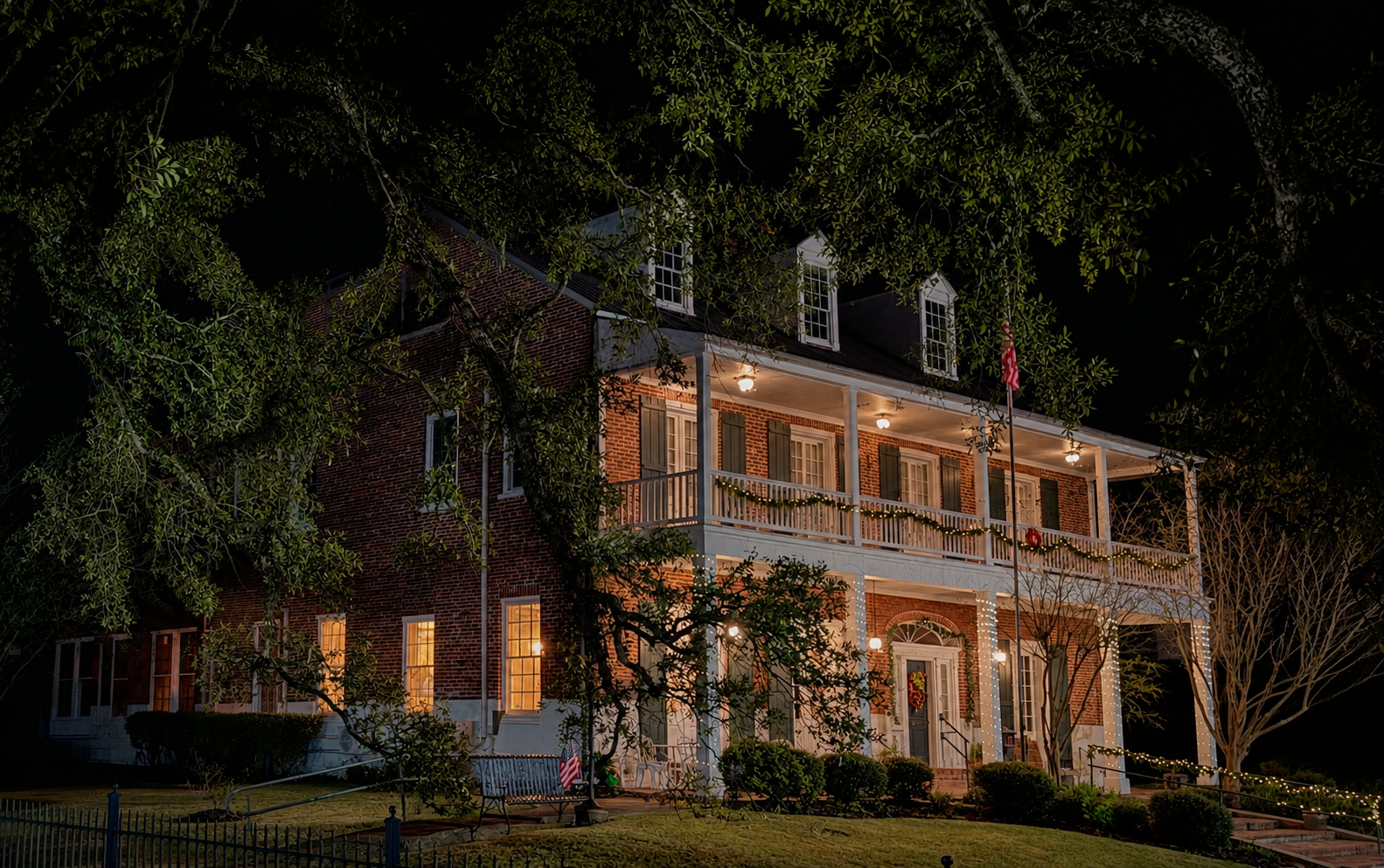
Old Castillo Hotel, Evangeline Oak in the foreground
Maison, of course, is the French word for house, but in 19th-century Louisiana, particularly in French-speaking Creole and Acadian communities, maison carried a much broader meaning. Maisons were places you could have a drink in, or go to school in, or pray in, or spend the night in, and a well-built maison, one that endured for generations, would serve many purposes throughout its long life.
Maisons have incarnations. They go through periods of dormancy and revival, changing hands and changing purposes, sometimes falling silent for a time before coming to life again. The best old houses, as they say, have good bones, but an old maison is more than a sturdy skeleton. That’s what spending a night in the newly reopened Old Castillo Hotel helped me to understand. The brick walls of this two-hundred-year-old maison situated at the energetic heart of St. Martinville on the banks of Bayou Teche, well within earshot of the bells of St. Martin De Tours, enshadowed by the branches of the Evangeline Oak, form the shape of a living body that wants to be inhabited, that makes you feel like an honored guest even when you’re the only person in it.
I've felt something similar entering other maisons in St. Martin Parish—Maison Stéphanie, Maison Duchamp, Maison Olivier, Maison de Tours, Maison Madeleine, Duchamp Opera House and St. Martin de Tours, which is a kind of maison de Dieu. I haven’t had the pleasure of venturing inside the old opera house in Breaux Bridge, the St. Martin Parish Courthouse in St. Martinville, or the Presbytère of St. Martin de Tours, but I suspect that the feeling would be much the same: the uncanny sensation that the residue of a distant century somehow still suffuses the air.
Maisons, like all living things, breathe differently in the dark. That’s the thrill of spending a night in one. Maisons have personalities. Maisons creak. Maisons groan. Their staircases are always eager to put on a grand show for you, and after the sun goes down they exert a palpable pull. Maisons are a lot like magnets.
Day
The Old Castillo Hotel attracted a large crowd on the day of its grand re-opening, October 21, 2026, the baby blue sky thinning mellowly into autumn. The mayor was there. City council members. The head of the Chamber of Commerce. History buffs eager to see the interior. Parish tourism representatives. Graduates of Mercy High School who had attended school in the building. The owner of the hotel, Peggy Hulin, was there, as were Reed and Rachel Rudasill, the hotel’s new operators. We all had been drawn to the front steps of the old maison to witness its reawakening, and the occasion was memorably marked by a speech from the Lieutenant Governor.
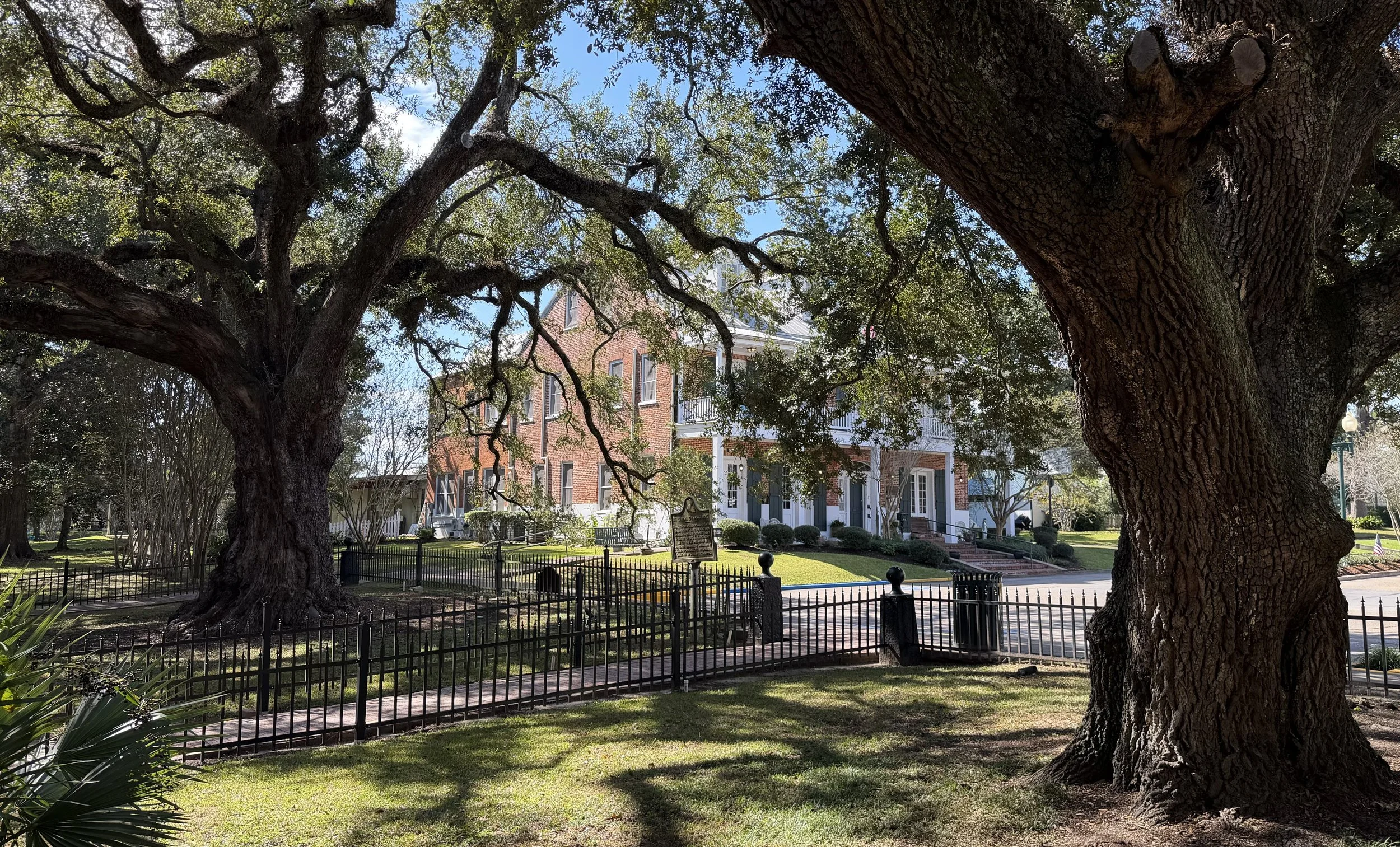
Old Castillo Hotel between Evangeline and Belle Marie
The two-and-a-half-story brick building, with its dormered gable roof and upper and lower galleries, combines the regional character of Louisiana Creole buildings with the symmetry and classical proportions of Greek Revival. Inspired by the temples of ancient Greece, Greek Revival, was one of the most fashionable and enduring architectural styles in 19th-century America, particularly the American South. With its emphasis on symmetry, classical proportions, rectangles and stately columns, the movement left a distinctive mark on southern Louisiana.
The expression of monumentality was central to the Greek Revival style, but building materials and architectural forms could vary considerably within that aesthetic. Though we tend to associate the style with the grand, white-columned mansions still gracing the streets of old Louisiana towns, Greek Revival buildings were also commonly constructed of brick. Abundant, sturdy and durable, brick was one of the principal building materials of the Greek Revival period in the American South, and in fact both the exterior and interior walls of the Old Castillo Hotel are of solid brick construction, contributing to the old maison’s formidable presence. Above the brick walls rises a timber-framed roof enclosing the attic story.
In Louisiana, the style frequently mixed with older Creole building traditions, combining classical geometry with practical accommodations to the subtropical climate. Broad galleries, high ceilings, tall windows, and generous ventilation softened the formality of Greek Revival design to create buildings that were at once both stately and hospitable. Maison Duchamp, just down the boulevard from the Old Castillo Hotel, is a good example of this architectural hybrid, with the classical austerity of its façade softened by the lacy ironwork of its galleries: a marriage between ancient Greece and New Orleans.
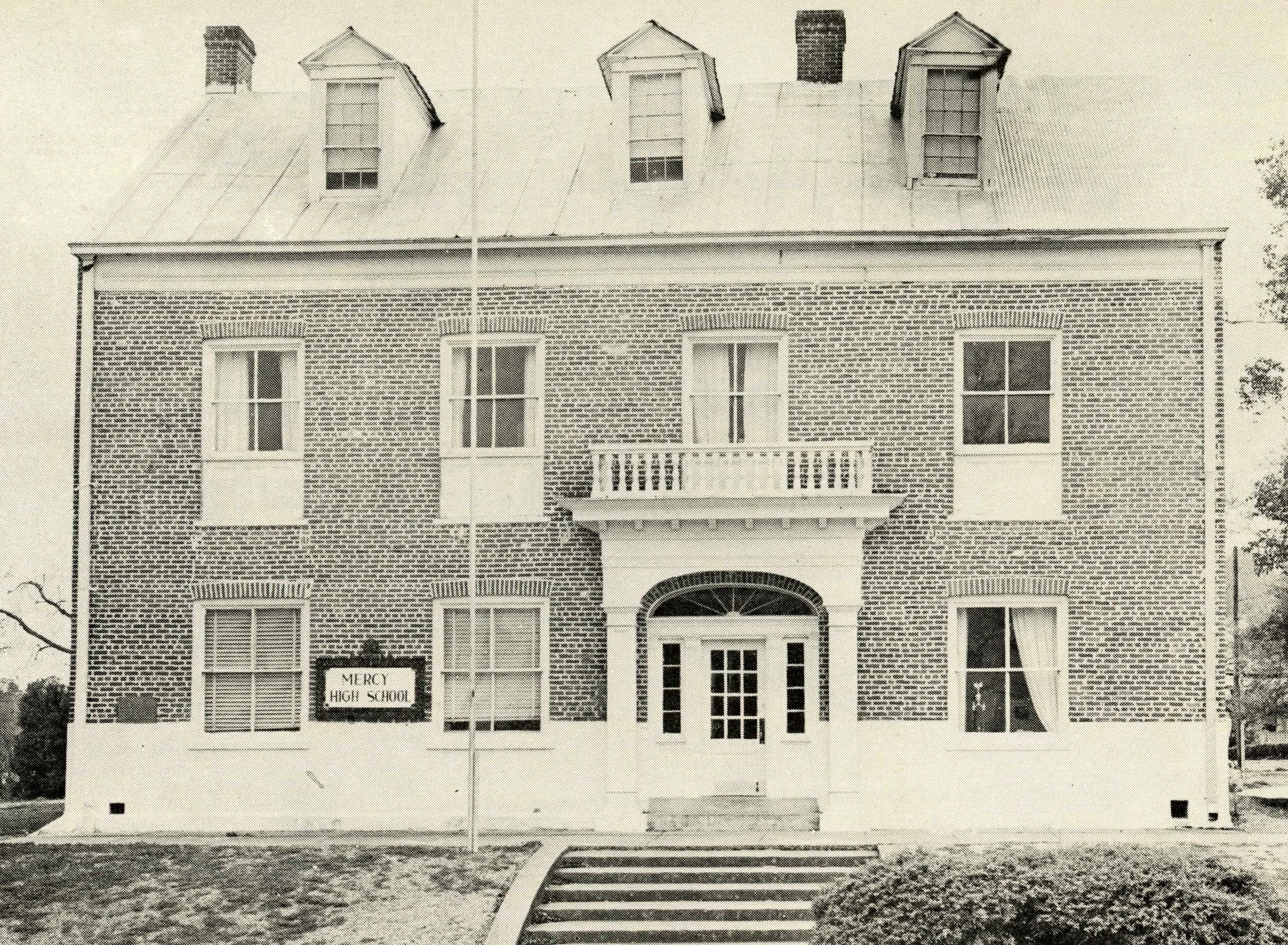
Exterior view of north side of building taken March, 1977—Henri Clay Bienvenu
At the time this photograph of the Old Castillo Hotel was taken, it served as the main building for Mercy High School. The original upper and lower galleries on the front had been removed from the original architecture, leaving the façade bare but for one small balcony at the upper level above the main entrance. In this exposed state you can see clearly the regularity of the old building’s bones, punctuated by two chimneys and three dormer windows across the attic.
“Its exceptionally sound construction may account for the fact that it has been continuously occupied for over one hundred forty years,” wrote the authors of A History of the Mercy High School Building, from which the above photograph was taken. The Old Castillo has had a remarkable number of incarnations in its nearly two centuries of life. Built in the early 1930s by St. Martinville merchant Jean Pierre Vasseur, the handsome two-story brick building began as a private residence before becoming one of the town’s most celebrated gathering places.
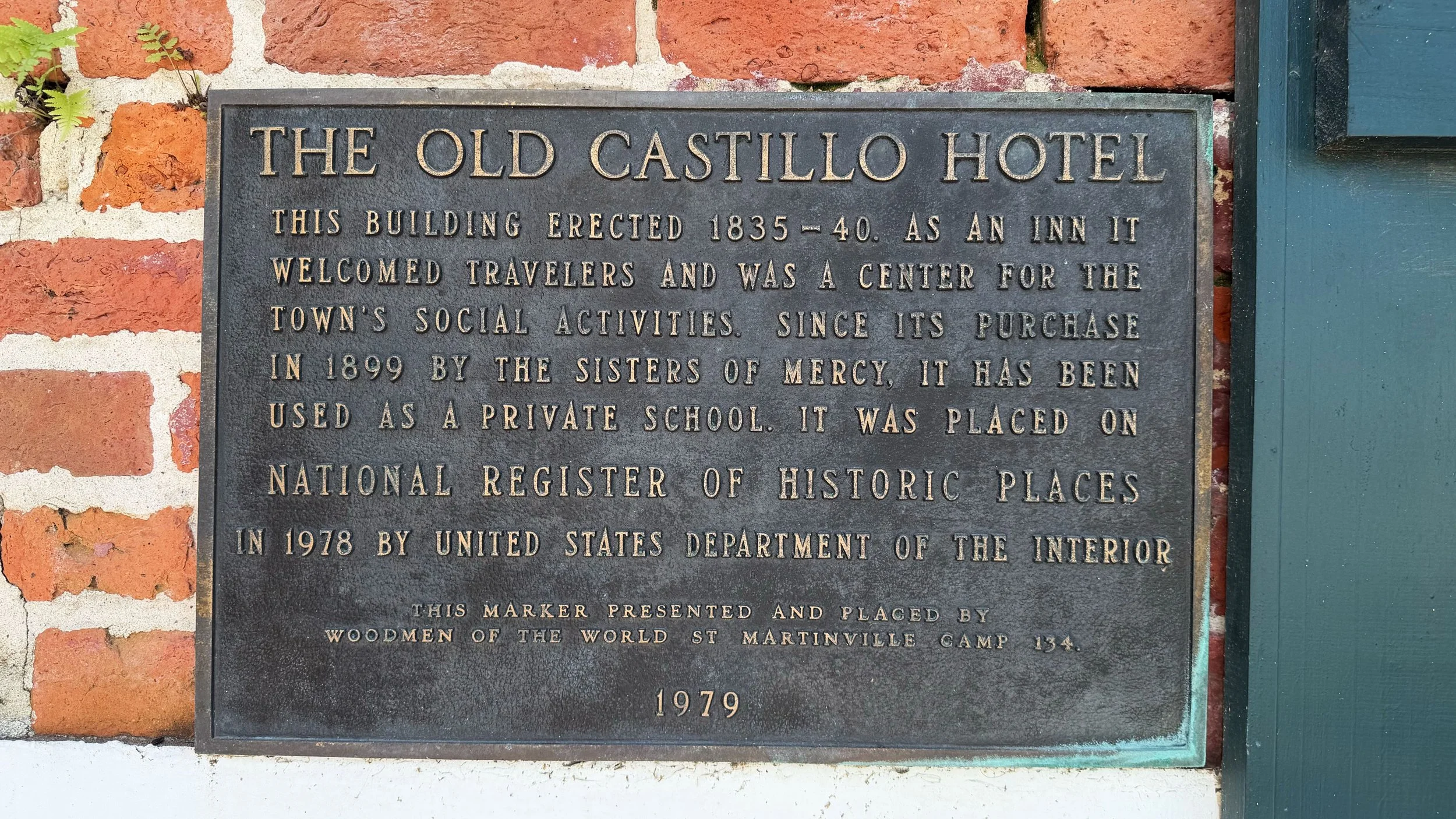
National Register of Historic Places marker
By 1840, its Union Ballroom was hosting festivities, and in the decades that followed, the building welcomed steamboat travelers, served elaborate dinners, and passed through a succession of owners. From 1858 to 1876, under the proprietorship of the Hesse brothers, it was known as Maison des Allemands—House of the Germans. Later, it acquired the name of its memorable proprietress, Madame Castillo.
In 1899, following her death, the Sisters of Mercy purchased the property and transformed the old hotel into a school. The building survived the great flood of 1927 and continued its educational life as Mercy High School, where generations of St. Martin Parish girls attended classes until 1986.
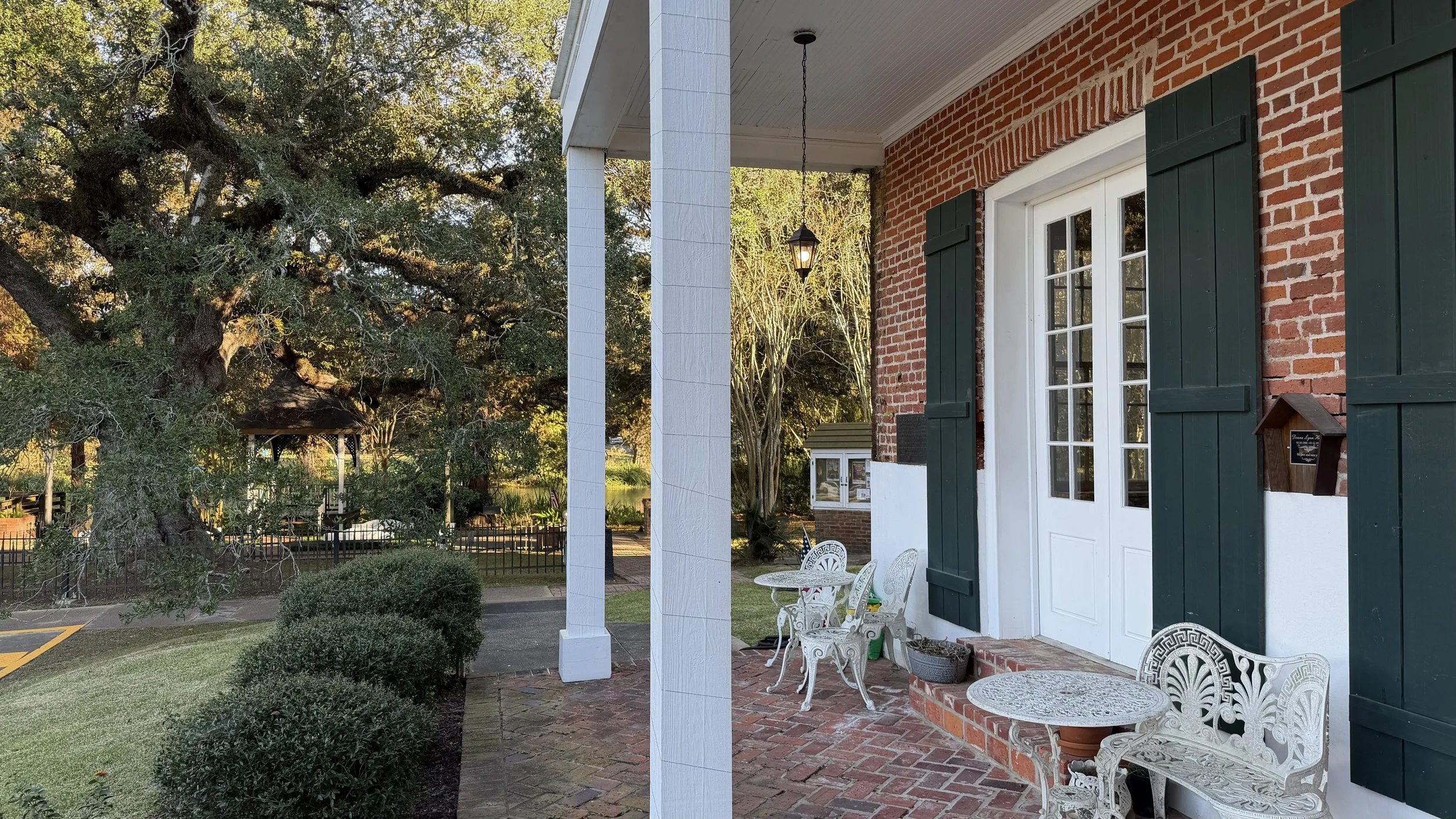
Lower gallery with a view of Evangeline Oak Park
In 1979, the building was added to the National Register of Historic Places in recognition of its architectural and historical significance. In 1987, Peggy Hulin purchased the maison and returned it to its original function as a place of hospitality, operating it as a restaurant and bed-and-breakfast under the name La Place d’Evangeline. For more than thirty years, she served as the historic building’s custodian. Now, in 2026, its doors have reopened to overnight guests. The same sturdy two-hundred-year-old bones eagerly reawakening.
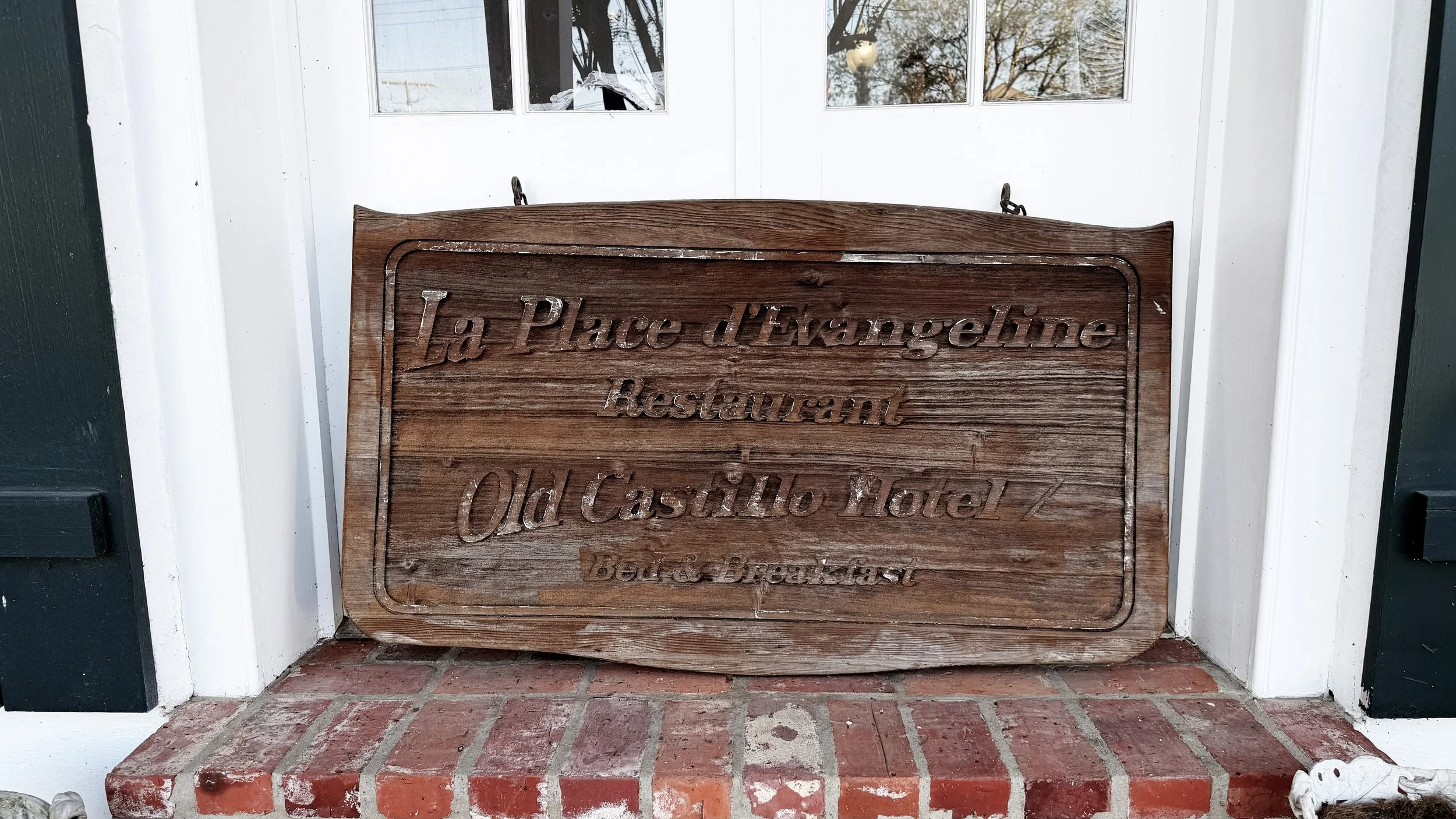
La Place d’Evangeline Restaurant sign
Afternoon
You can book the entire hotel, or you can make reservations for individual rooms, for example, the Chambre d’Evangeline or the Chambre de Gabriel, where I spent the night. The day before my arrival, I received a code for the front entrance.
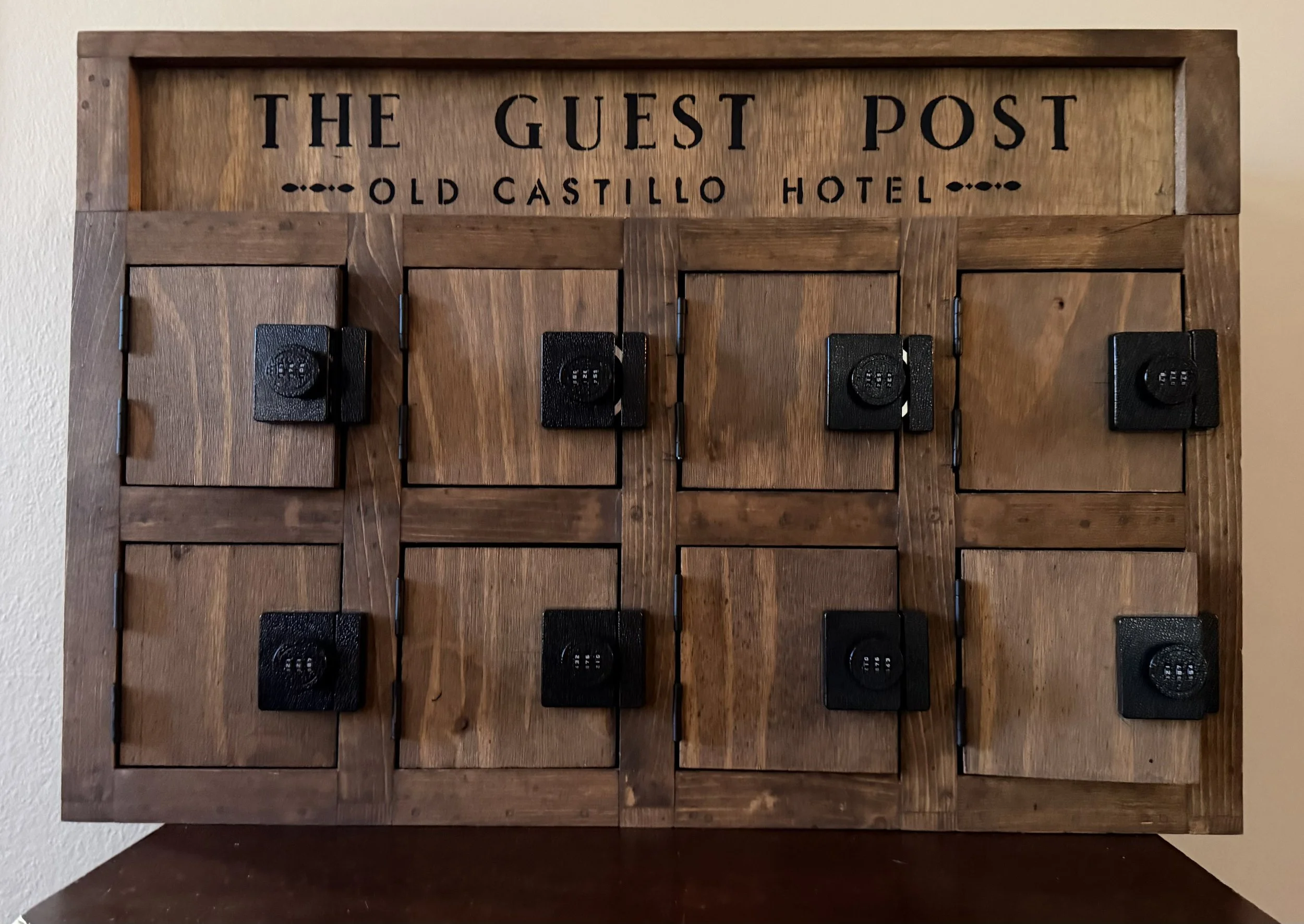
Guest key station
There was no need to check in at a reception desk or wait for someone to let me inside. I simply entered the code, opened the front door, and stepped into the entryway, where my room keys were waiting inside a cabinet of small combination lockboxes. A few turns of the dial, and I was officially a guest of the Old Castillo Hotel.

Downstairs salon
Free street parking was plentiful just outside the hotel, and once inside, I settled in at my own pace, wandering through the common areas, admiring the old photographs lining the walls of the breakfast room and taking in the paintings and historical artifacts displayed in the main salon, including a lovely new mural by Sarah Melancon.
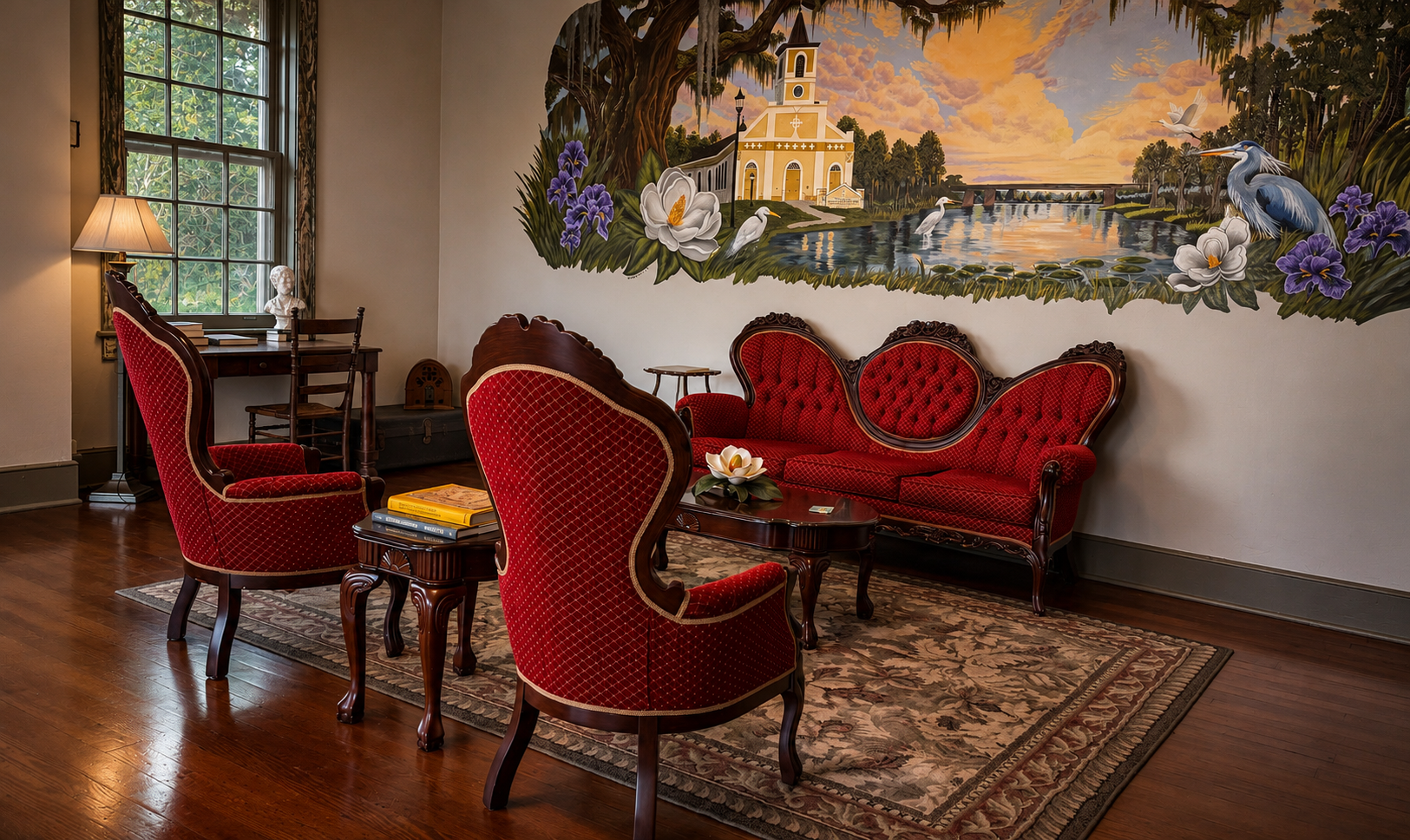
Mural by Sarah Melancon
The Old Castillo offers seven individually furnished guest rooms, each with its own name, personality, and private bathroom. The names themselves are a little tour of local history and geography: Chambre d’Evangeline, Chambre de Gabriel, Chambre de Longfellow, Chambre de Teche, Chambre d’Acadiane, Chambre de Jardin, and Chambre de Petit Paris.
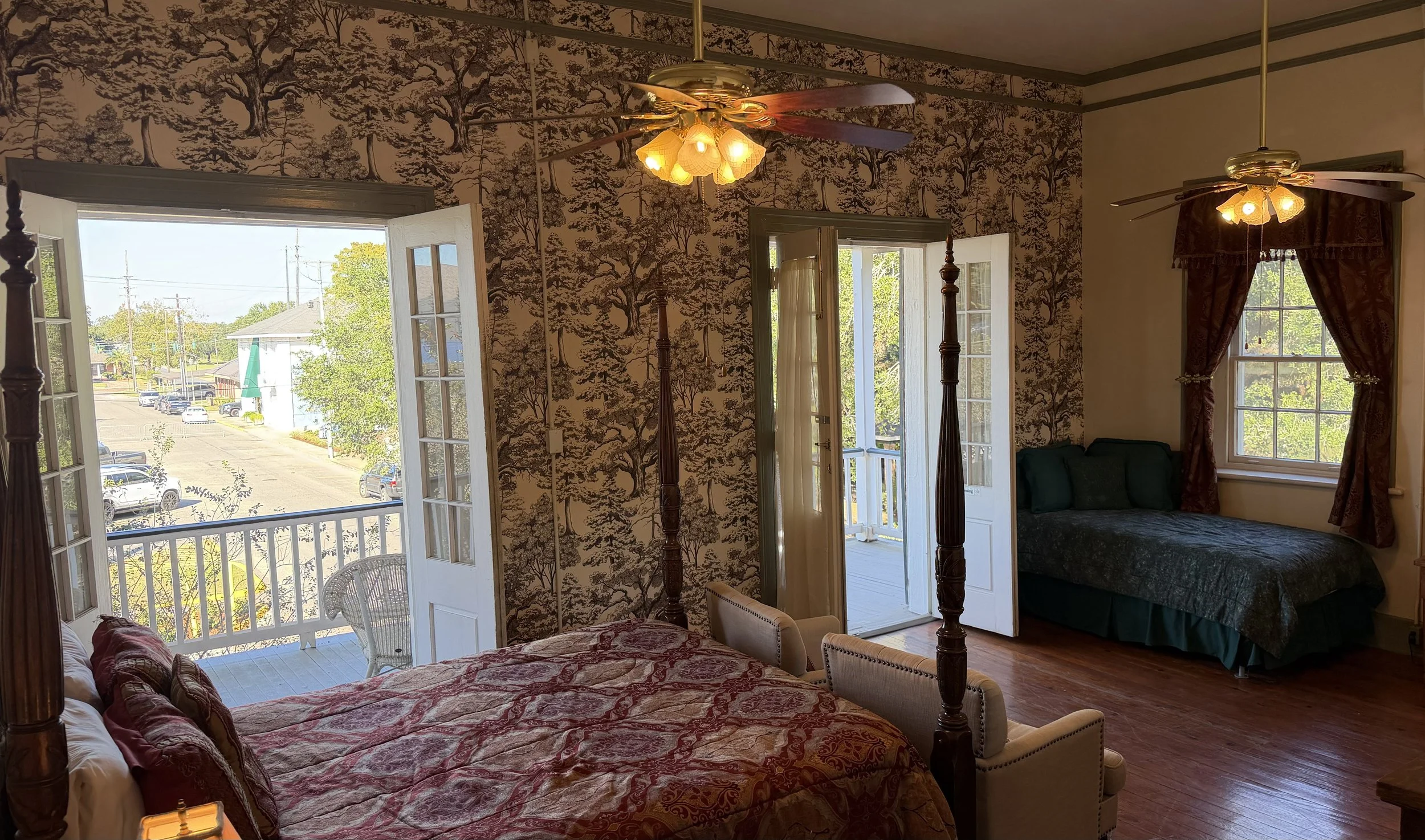
Chambre d’Evangeline opening onto upper gallery
The rooms vary in size and arrangement, with antique furnishings, handsome four-poster beds, and views of the gardens or surrounding historic district. Two upstairs rooms open directly onto the shared upper gallery, and there is a third entrance to the upper gallery through an upstairs common room. Modern conveniences, including air conditioning, Wi-Fi, and private bathrooms, have been incorporated without sacrificing the old-fashioned character of the place.
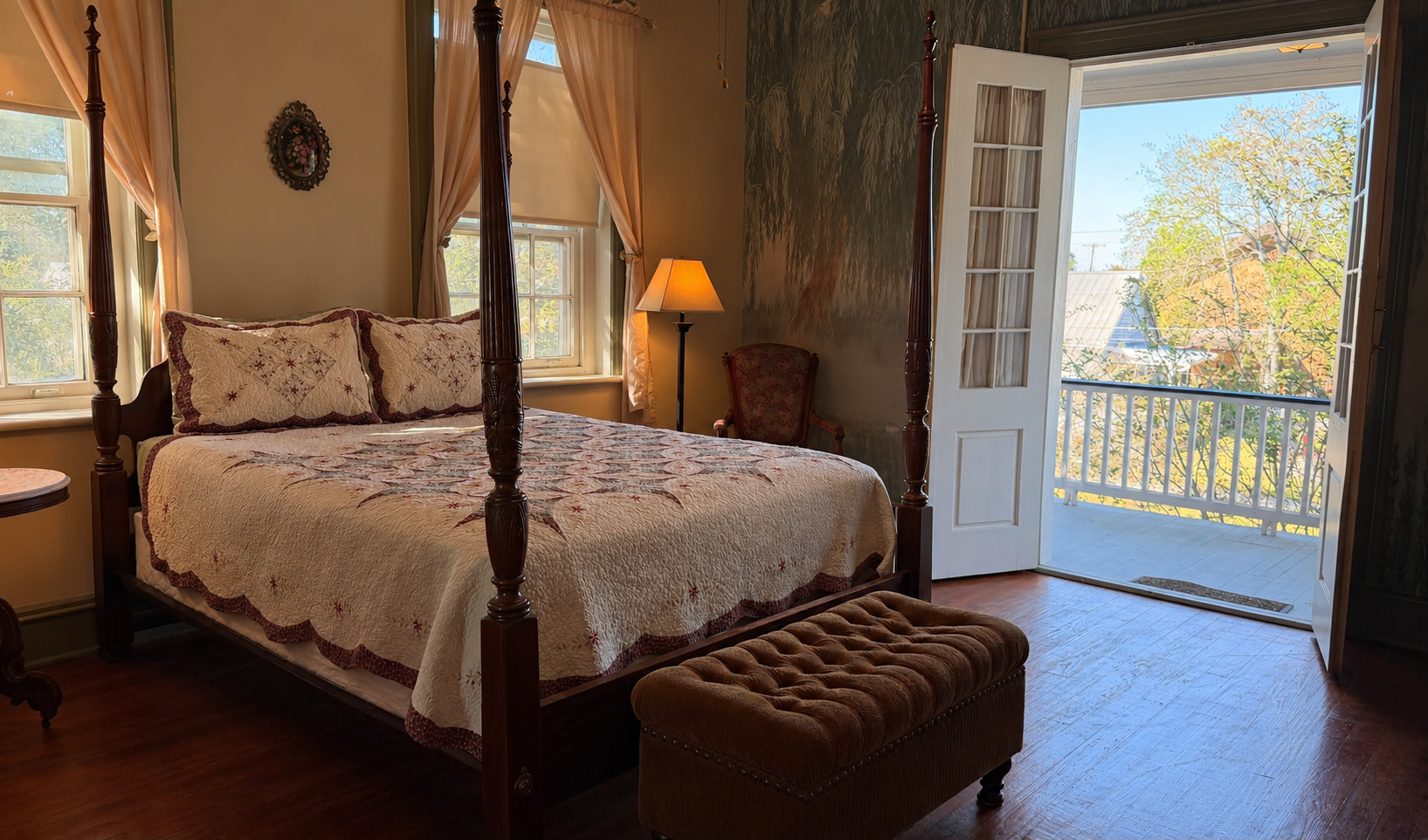
Chambre de Gabriel opening onto upper gallery
Twilight
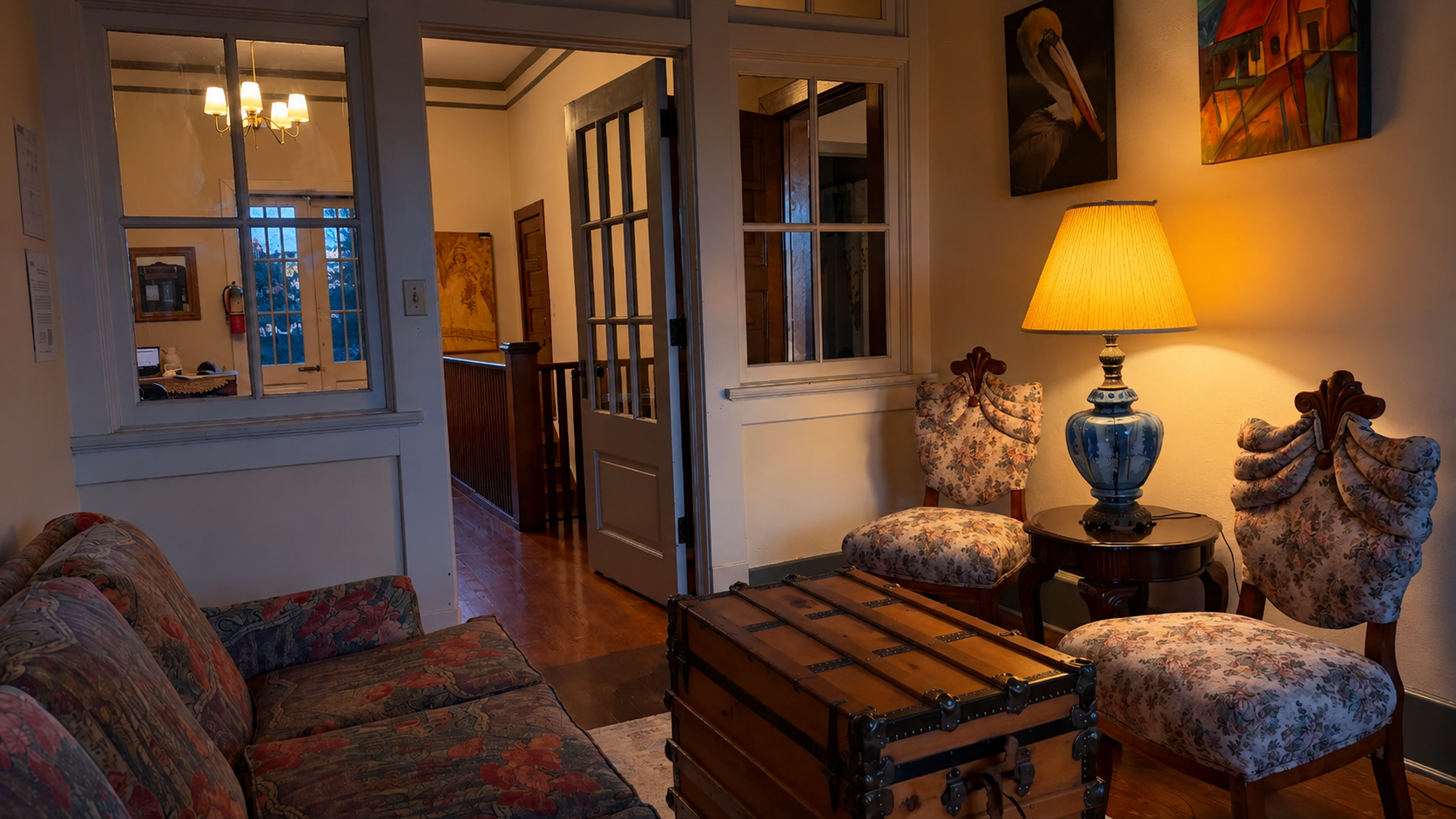
Old book room upstairs
The pleasures of the Old Castillo Hotel extend well beyond the bedrooms. Guests have the run of several inviting common spaces, including a salon and breakfast room downstairs, and a parlor and old book room upstairs, not to mention the lower gallery and outdoor courtyard. The variety of shared spaces makes the hotel equally suited to a solitary overnight stay, a romantic weekend, or a gathering of family and friends. The entire seven-bedroom property can be reserved for groups of up to eighteen.
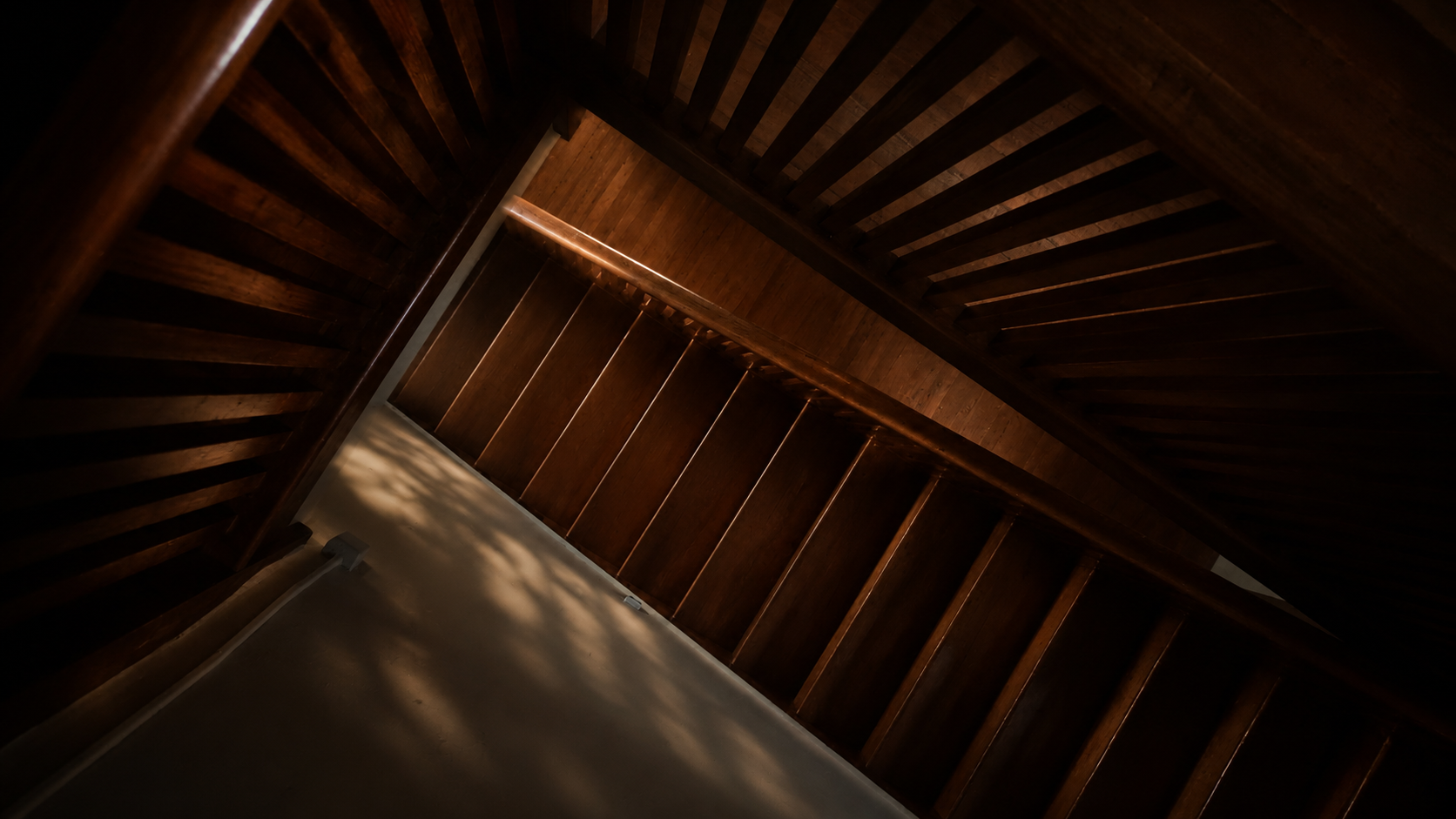
Main staircase
After wrapping up some work on my laptop in the salon downstairs, I spent some time photographing the main staircase, stopping every few steps to take in the changing perspectives. There’s nothing like an old staircase to transport you back in time. Doorways deliver you in a single step from one space into another. A staircase makes the passage gradual. You can linger in the interval, running your hand along the banister and listening to the dark wood croak beneath your feet.
If the downstairs common spaces lend themselves to socializing, the upstairs common spaces invite quieter pursuits, like curling up with a good book. At the top of the main staircase is a charming parlor area furnished with beautiful coffee-table books and other books of historical interest. It didn’t immediately dawn on me why there should be two enormous unabridged dictionaries in the bookcase.
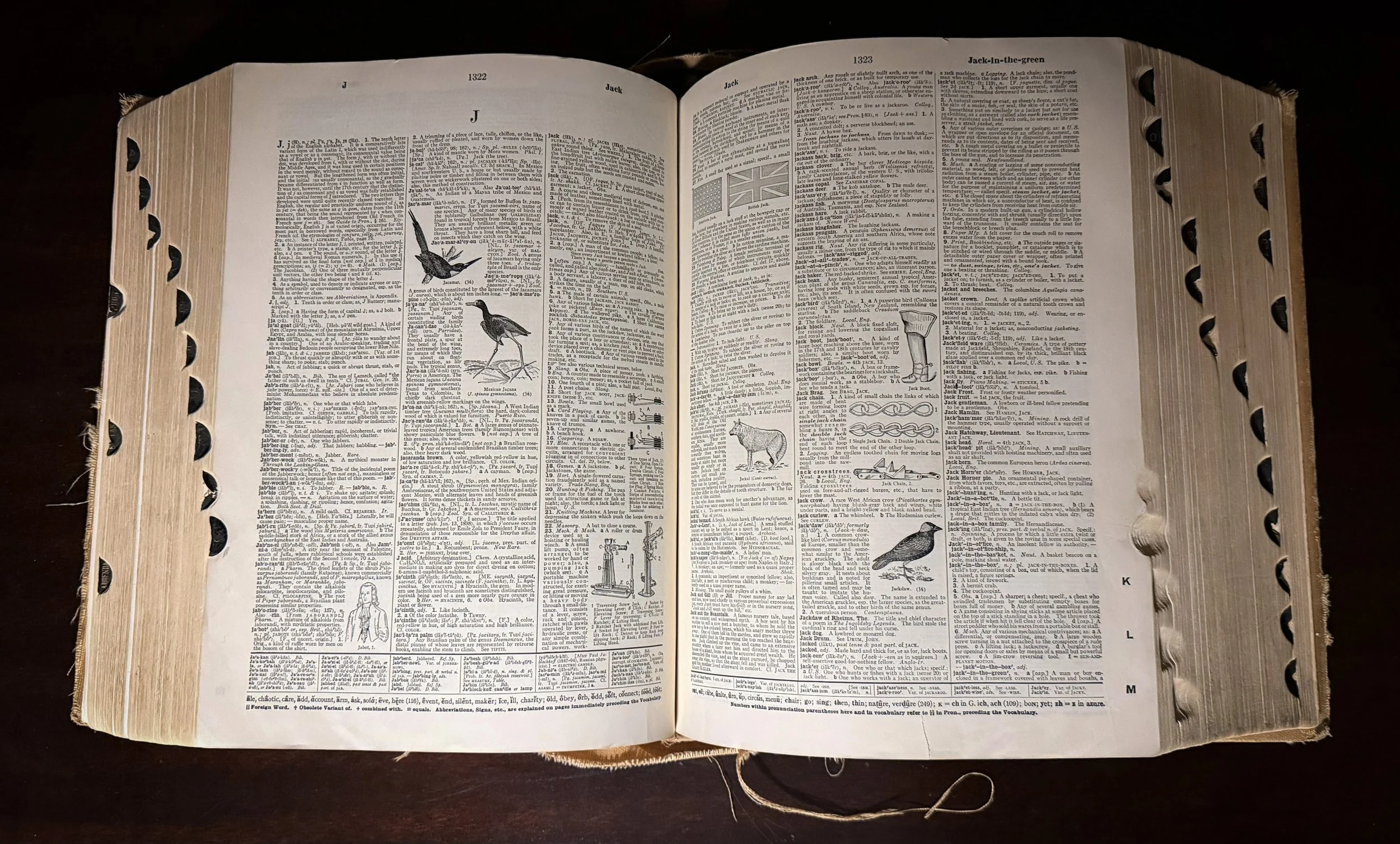
Webster’s New International Dictionary of the English Language, Unabridged, 1935
They were relics of the days when the old maison served as a Catholic school for girls. These giant books were the browsers then, their thumb indexes something like the tabs we keep open on our laptops today. I had learned from a former student that the clacking of typewriter keys and the ringing of carriage bells once filled the upstairs room where Sister Ursula taught typing, the room that now goes by the name Chambre de Gabriel. There was something profound about that continuity. There I was, typing away in the old typewriter room as the sun went down, only now the keys made scarcely a sound.
Night
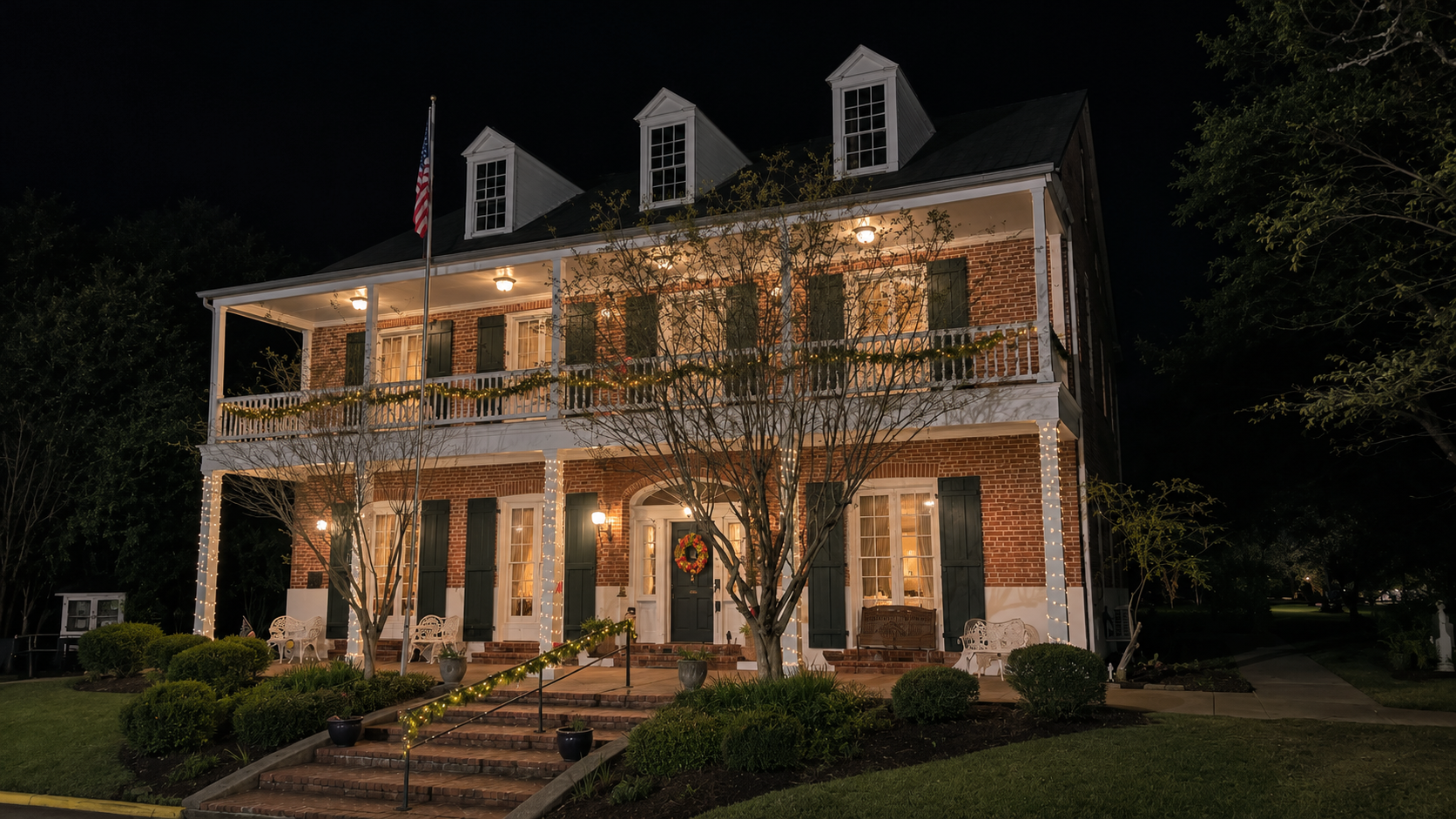
Old Castillo Hotel, decorated for Christmas
To fully appreciate a maison, you have to consider the world beyond its walls. Nowhere is this more apparent than in downtown St. Martinville, where a few steps in any direction opens a passage into the past.
We walked down Evangeline Boulevard toward Duchamp Opera House, turning right at Maison Duchamp to make our way across the church square, past the beautifully illuminated Presbytère and St. Martin de Tours, to El Corazón, which has been a welcome addition to the city. Over sizzling fajitas, I was reminded that for all its connections with the past, St. Martinville has an appetite for the future as well. St. Martinville, generally regarded as Louisiana’s third-oldest town, has enjoyed something of a renaissance in recent years, with historic buildings finding new purposes and new businesses breathing life into its centuries-old streets.
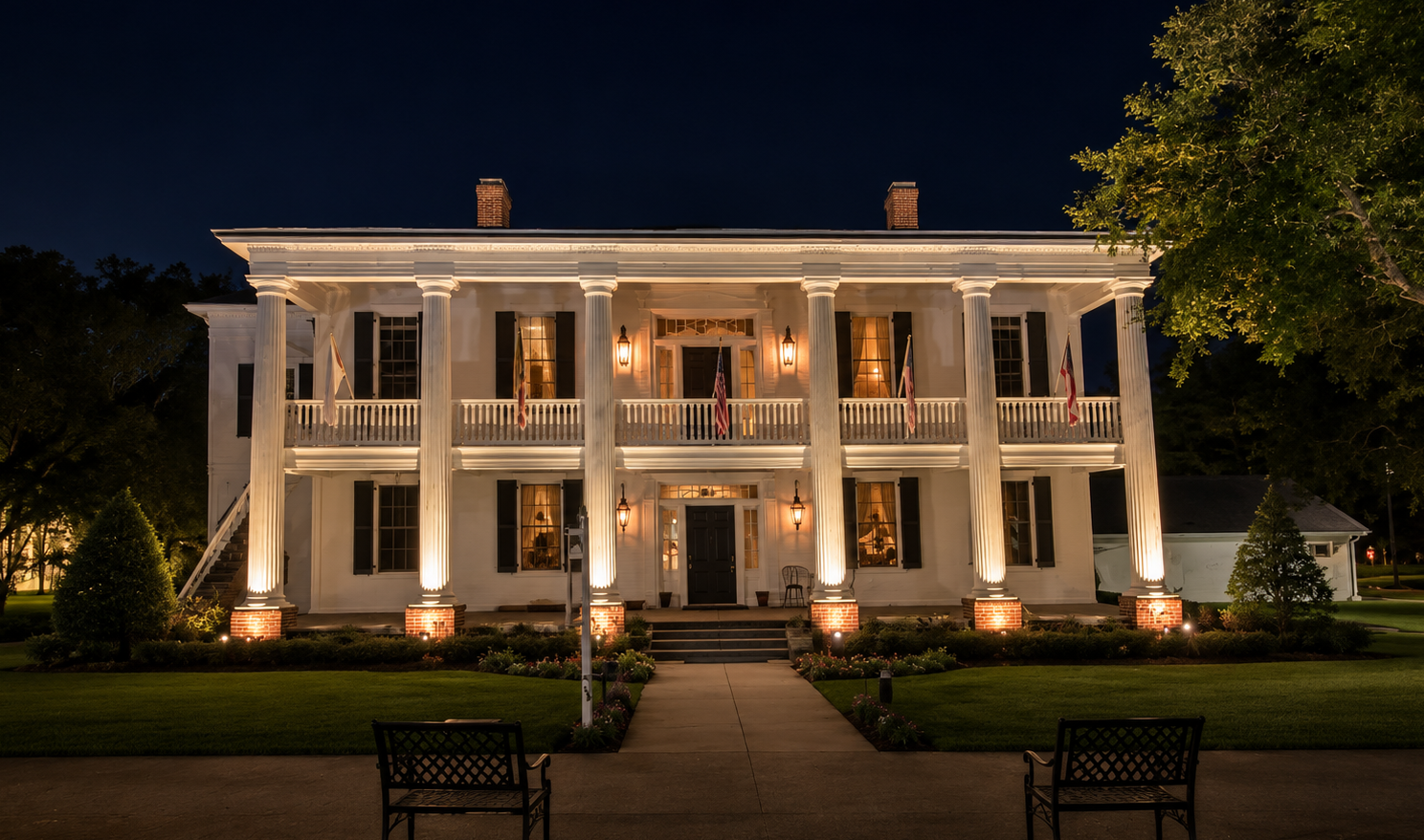
Presbytère of St. Martin de Tours Catholic Church
We took the long way back to the hotel, church bells embroidering the clear night air. We stopped to linger in the old churchyard and gaze at the bronze statue of Evangeline, which cuts a haunting figure against the stained glass windows of St. Martin de Tours after dark. Her name is a thread that knits this little corner of the world together—the statue, the boulevard, the oak, the park. Indeed, the history of the Evangeline Oak Park is intimately entwined with that of the Old Castillo Hotel.
In 1902, when the limbs of the original Evangeline Oak were axed in a shocking act of vandalism, the community rallied around another live oak growing on the bayou near what was then the Sisters of Mercy convent and the Old Castillo Hotel. The grounds surrounding that tree were developed into a public space known as La Place d’Evangeline, which became the Evangeline Oak Park we know and love today.
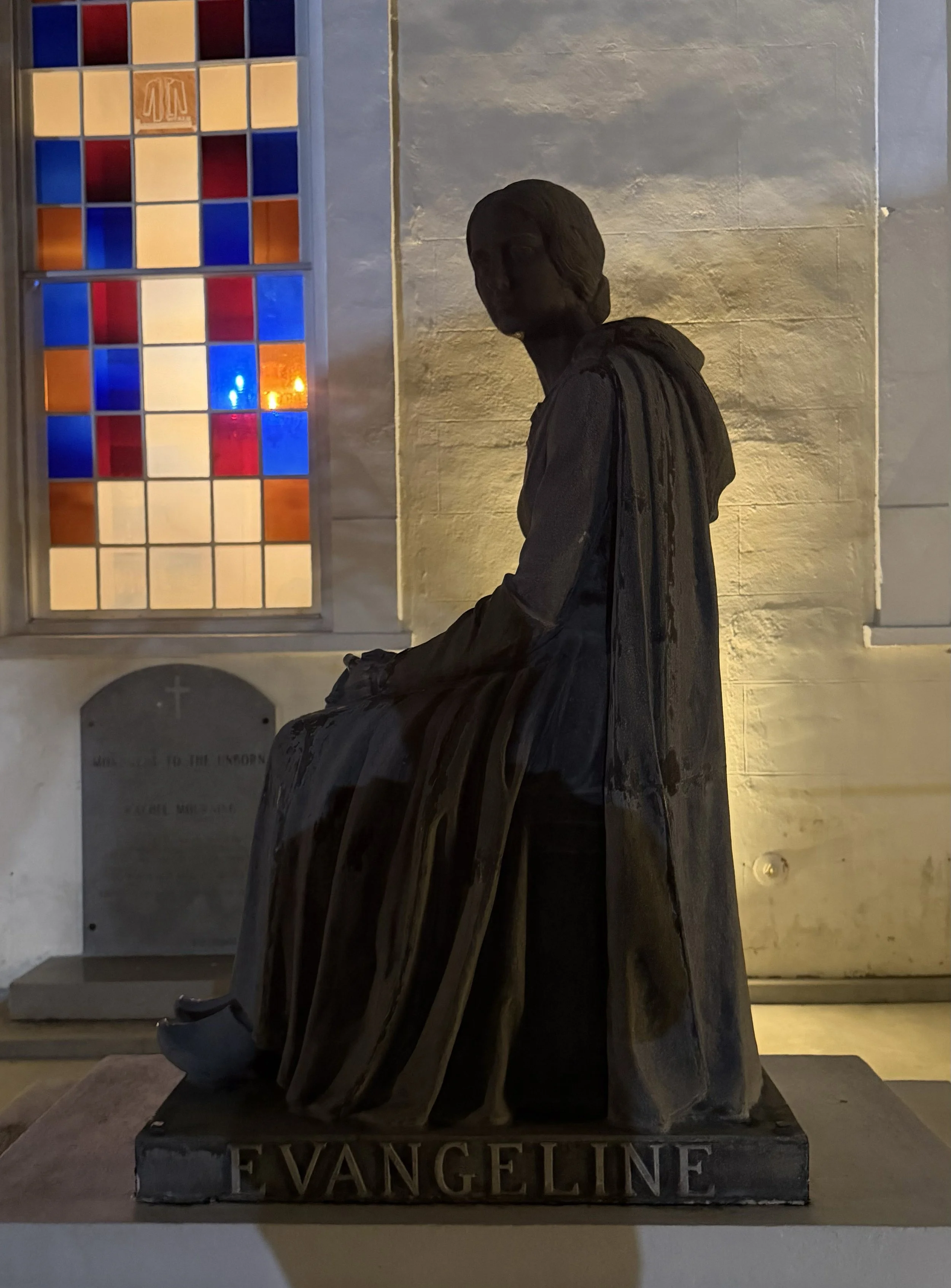
Statue of Evangeline—St. Martin de Tours
Almost a century later, when the Old Castillo Hotel took on new life as a bed-and-breakfast, the maison assumed the name La Place d’Evangeline for its restaurant. Fitting that the name of a public gathering place should spread from the surrounding grounds to the building itself, as though they had always been of a piece. Live oaks, like old maisons, have a way of encompassing the world around them.
Morning
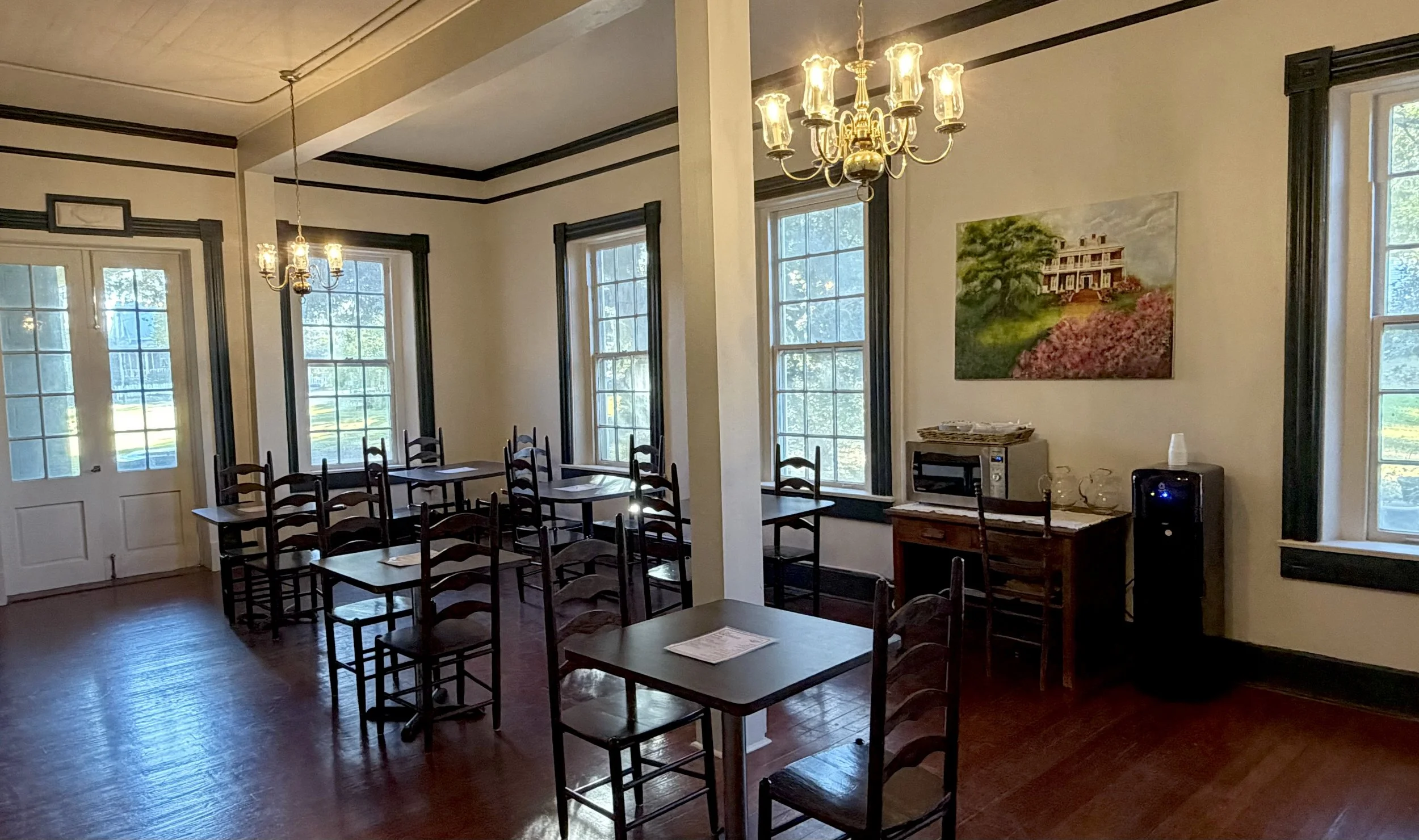
Breakfast Room
The morning light drew me downstairs to the breakfast room, where the old Mercy High School sign and class photographs adorn the walls. Nuns in black habits appear among generations of young women whose changing hairstyles and fashions mark the passage of the decades. I must have spent half an hour examining the photographs, which span the years from 1919 to 1986, progressing from the soft sepia tones of the earliest portraits through black and white to the faded colors of more recent decades. A small crucifix above the doorway was another touching relic of the building’s former life, another story quietly awaiting its telling on a future visit.
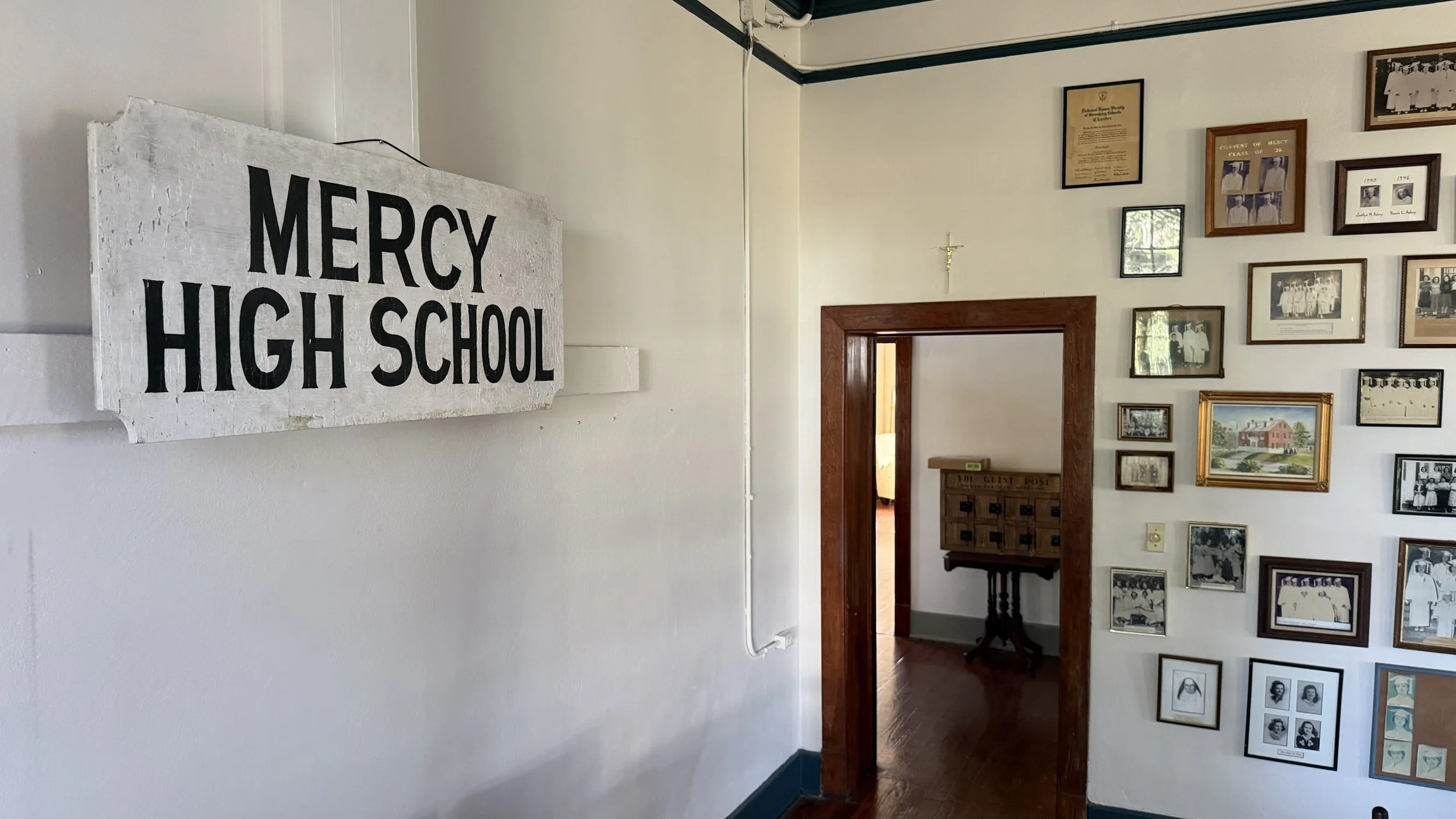
Breakfast Room
Here, in what was once the school lunchroom, the photographs seem to suggest that these students, many of whom have grown old and passed away, have never completely departed the premises. Carole Lançon, who attended Mercy from 1971 to 1975, recalled to me how the life of the school often spilled beyond its brick walls onto the old maison’s lush lawn.
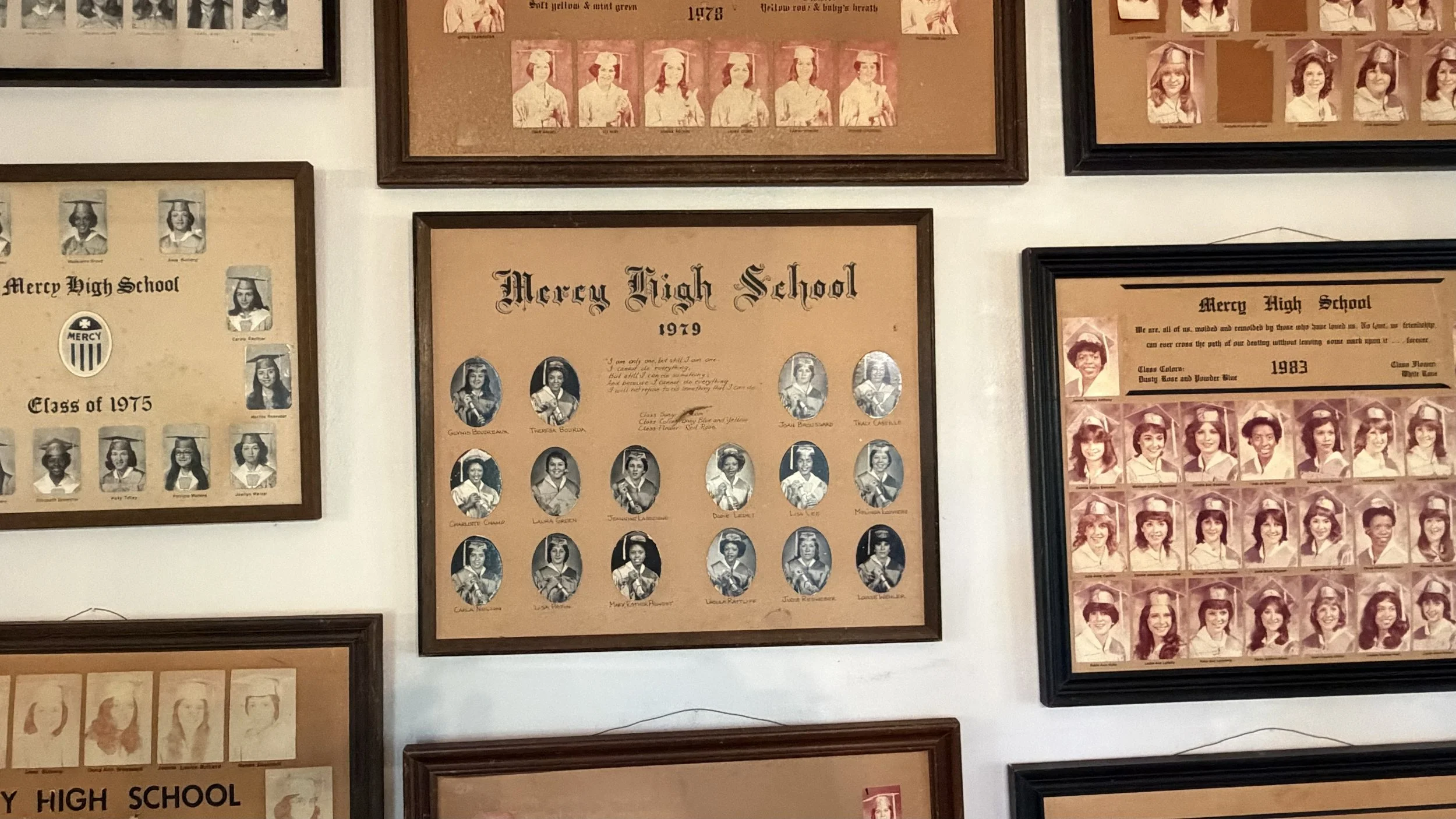
Mercy High School senior portraits, 1919–1986
Beneath the spreading branches of a majestic live oak, whose low, sweeping limbs seem purposefully arranged for climbing, she remembers learning about ancient Greece while enjoying fruit salad and orange juice with her classmates—ambrosia, the food of the gods, and nectar, the drink of immortality and eternal youth. On a dewy Louisiana morning, in the shade of that magnificent tree—surely at least three hundred years old—they might as well have been having the real thing. Fittingly, the live oak is registered with the Live Oak Society under the name Miséricorde, a French word meaning Mercy.
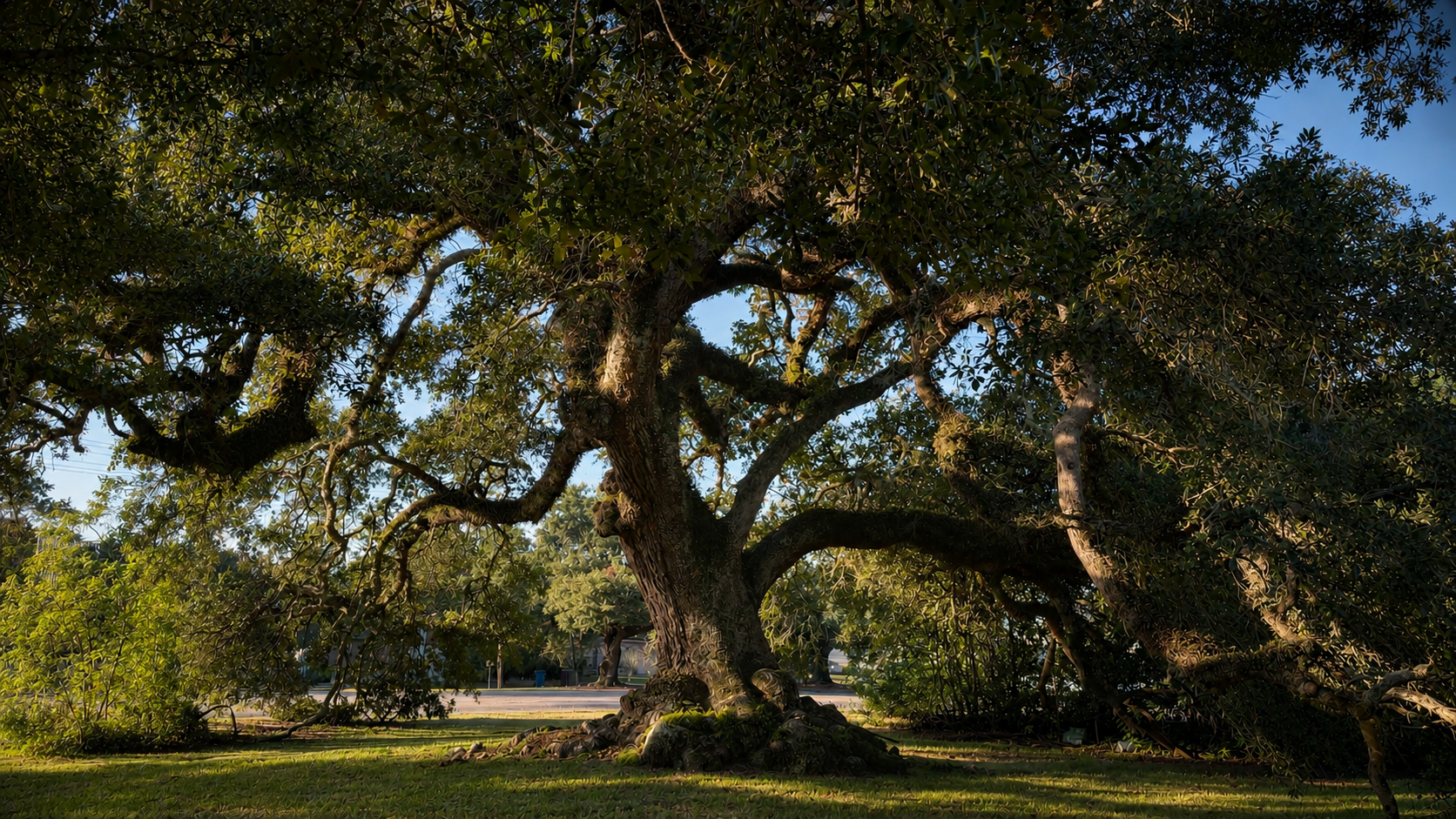
Miséricorde
Wordsworth memorably describes the aged branches of an oak making “a twilight of their own.” I love that turn of phrase. When we walked down the steps of the old maison and down Evangeline Boulevard, past Miséricorde, it was easy to see how apt his expression was. In the brightness of that Louisiana morning, the great tree seemed to inhabit a different hour of the day, or a different century even, enveloped in a greenish twilight of its own making.
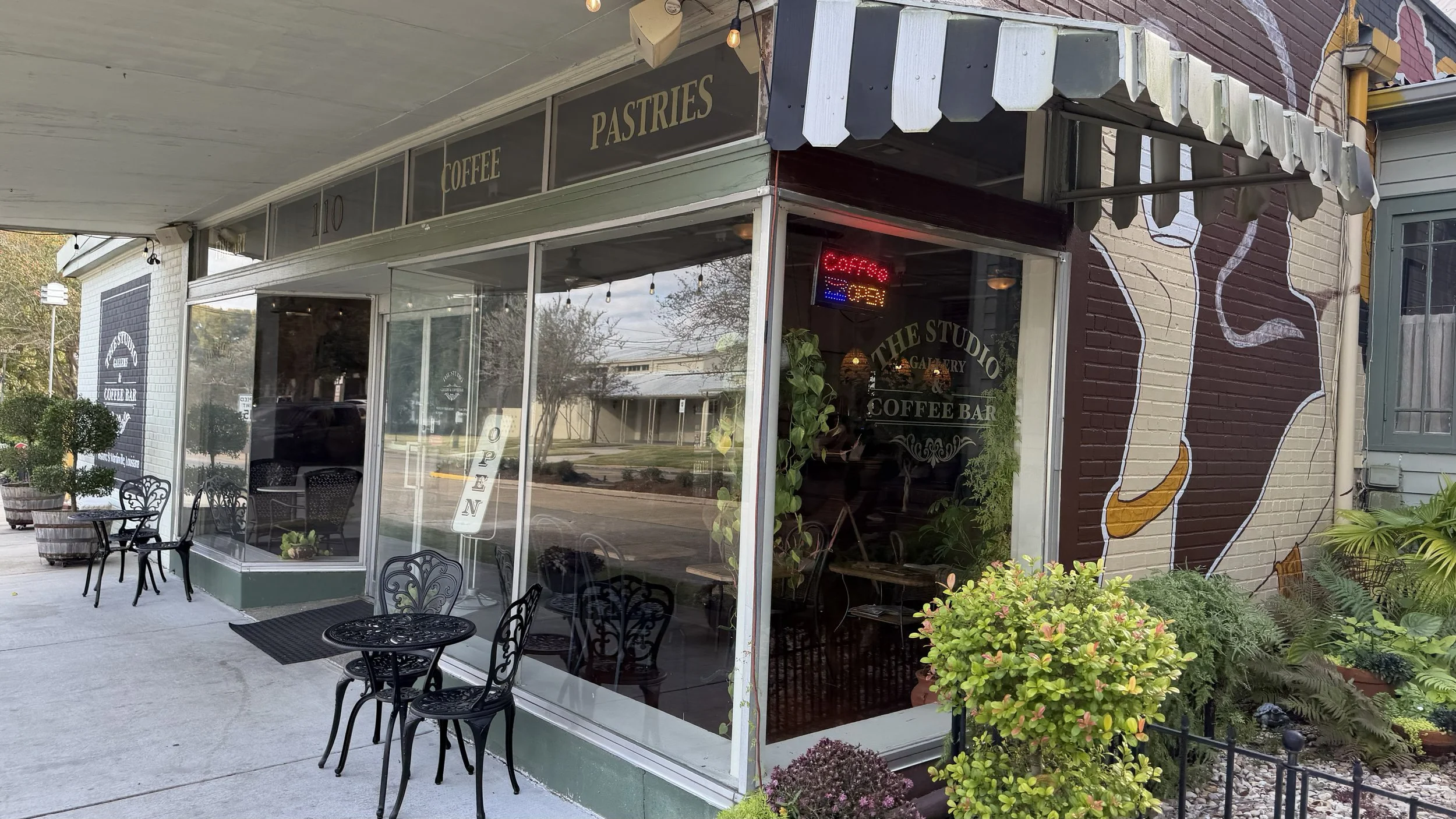
The Studio Gallery & Coffee Bar
A few steps farther brought us to the Studio Gallery & Coffee Bar, where a complimentary morning coffee and light breakfast awaited us as guests of the Old Castillo. Over lattes, we considered what our next adventure would be—renting a kayak from the self-service kiosk on the hotel grounds for a paddle on Bayou Teche, continuing our exploration of the historic streets of St. Martinville, with a stroll through St. Michael Cemetery, followed perhaps by lunch at St. John—and which adventures we would have to leave for our next visit to the old maison.