

We Can Ride Dragons
An interview with Desiree S. Evans
by Jude Theriot
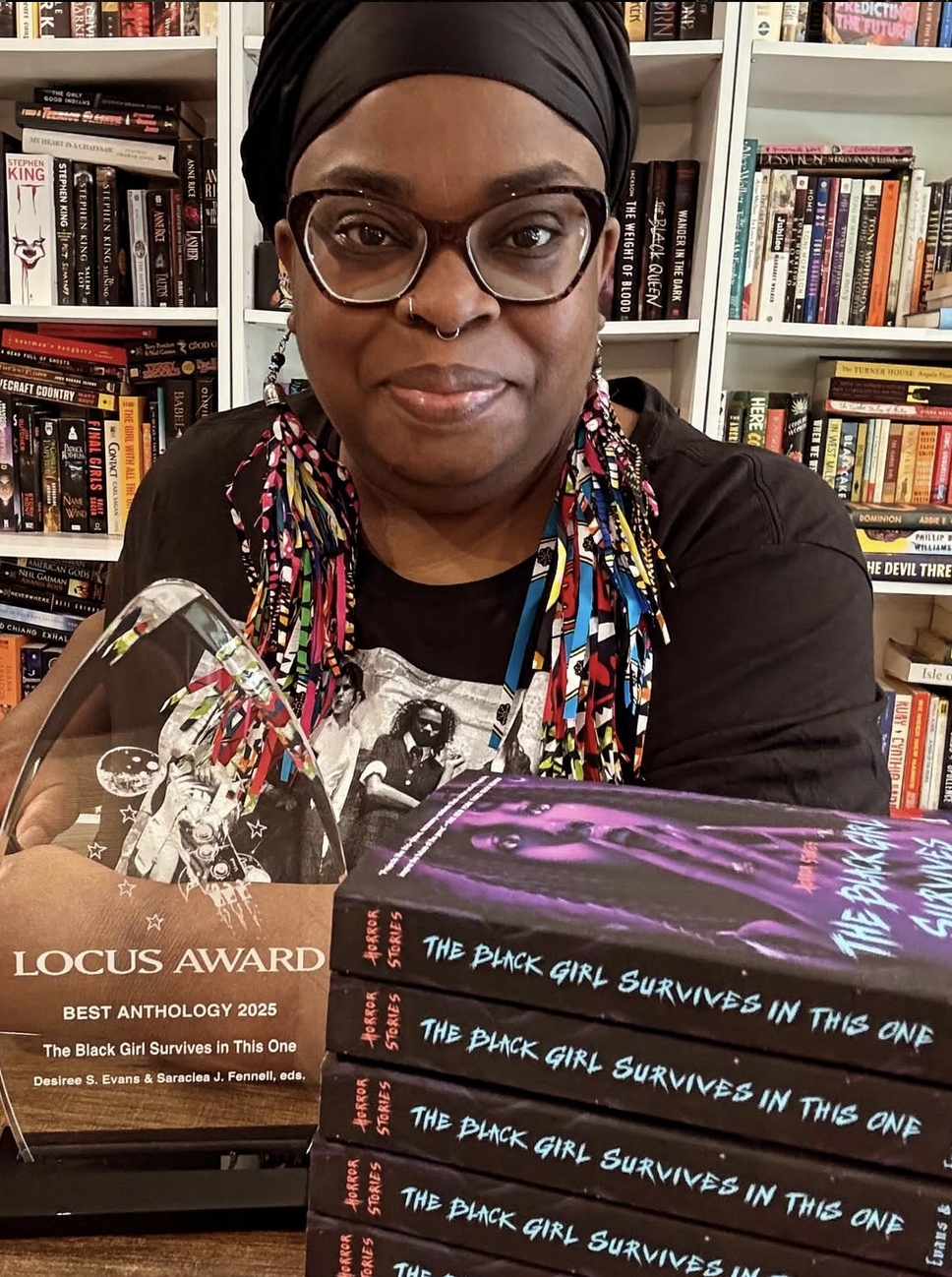
Desiree S. Evans wanted to be Lois Lane when she was a young girl growing up in St. Martinville, and in a way, that’s exactly who she has become—curious, fearless and drawn to stories that matter, guided by the belief that words themselves are an exquisite form of power.
The horror anthology, The Black Girl Survives in This One, which she co-edited, recently received the Locus Award for Best Anthology, one of the most respected honors in science fiction, fantasy and horror. The recognition reflects both the anthology’s imaginative reach and its resonance with readers across the genre.
Evans earned her MFA in Creative Writing from the Michener Center for Writers at University of Texas at Austin, one of the country’s most selective creative writing programs. She also holds degrees from Medill School of Journalism at Northwestern University and the School of International and Public Affairs at Columbia University.
Her path as a writer has been varied and winding, circling back again and again to themes that were present from an early age. I talked with Evans about growing up in St. Martinville, her love of horror, her journey as a writer, the history of the Black imaginary, the importance of place, the porous boundary between stories and real life, and ultimately what it means to survive.
As I was preparing for this interview and learning more about your background, I was struck by the range of writing you’ve done—fiction, journalism, communications, advocacy work. Take me back to growing up in St. Martinville. Is writing something you always knew you wanted to do?
Yeah, that was my first love. I think I wanted to be Lois Lane when I was little. I always loved writing and reading. So that was, like, my thing. When I think back to St. Martinville, it was me in the library. I used to walk to the local library in St. Martinville.
Back when the library was on the bayou by the bridge?
No, this was the new one they built in the 90s. It was right near where we were living. Maybe a ten-minute walk from there. That was my home base that was not my home. And I was always a reader in school as well. I remember when I was in, gosh, I was in junior high, there was this program called the Accelerated Reader Program, and they would give you points per book, and at the end of the year, you would add up the points that you got from all the books that you read, and they would give you a prize, one of those little trophies. But that was my thing in junior high. I said, “I’m going to beat the record.” Because I was always in the library. I remember the year that I graduated eighth grade, I beat the record. I think I doubled the record or whatever the highest record was. Blew it out of the water.
Reading was always something I loved to do. And I just really wanted an opportunity to actually write towards that as well. We didn’t have a school paper at St. Martinville High School, but when I went to Louisiana School, we had a school paper, and so that’s how I got involved with writing. I was like, “Oh, I really like writing about stuff. I like asking people questions. And, oh, this might be a career.” So I started writing for the paper, and I was the editor of the paper my senior year.
I didn’t really know a lot about writing. I remember growing up watching Linda Ellerbee on Nickelodeon. That was my idea of what journalism was. But I know when I went to the career counseling session, I thought maybe journalism? Because that’s something I can major in. And they were like, “Here’s the top journalism schools in the country. You should apply to those.” So that’s how I fell into the role of journalism.
I went to Medill School at Northwestern, which was one of the top journalism programs at the time. It was me and every other person who had been the editor of their school papers all in one place. And so it was just really . . . I learned a lot. I loved it. But I was also studying journalism at a time when journalism was rapidly shifting. Newspapers weren’t quite obsolete then, but within two years of me graduating, all the massive layoffs were happening. So anybody who got into the industry at that point . . . the industry was completely shifting.
This was the era of blogging?
Blogs were becoming more and more common. I feel like when I was in school, they were calling it the new media. The online media. Remember the new media before social media? That was “new media.” And this was before a lot of newspapers were online. We knew the internet was coming. It was going to change everything. And teachers were predicting this, but we didn’t really know until another five years. The industry was rapidly shifting, and I was like, “Okay, do I really want to stay in it?” So I freelanced for a few years. And then I just kind of was like, you know what? I think I want to do something that has the aspects of journalism, but wasn’t quite necessarily working in the newsroom. I felt very stifled in newsrooms in that setting. I just wanted to be able to do more of what I wanted to do.
And I knew that I couldn’t necessarily make a career out of freelancing full-time, but I knew that I wanted to be able to employ skills of journalism in other ways. And that’s kind of how I got into comms work, communications work, doing work for nonprofits and NGOs. I ended up going to grad school at Columbia. That’s where I studied international affairs. At that point, I was interested in writing around international issues, writing and working with NGOs, that kind of stuff was what I was really interested in doing, particularly around human rights work. And so I used the tools of journalism, but I didn’t really stay in the field, although writing was something I always still loved to do. So that’s how that initially evolved in that first half of my life. It was one way of me writing about the stuff that I saw in the world. Because I grew up reading and I just wanted to be able to write about the things I saw as well.
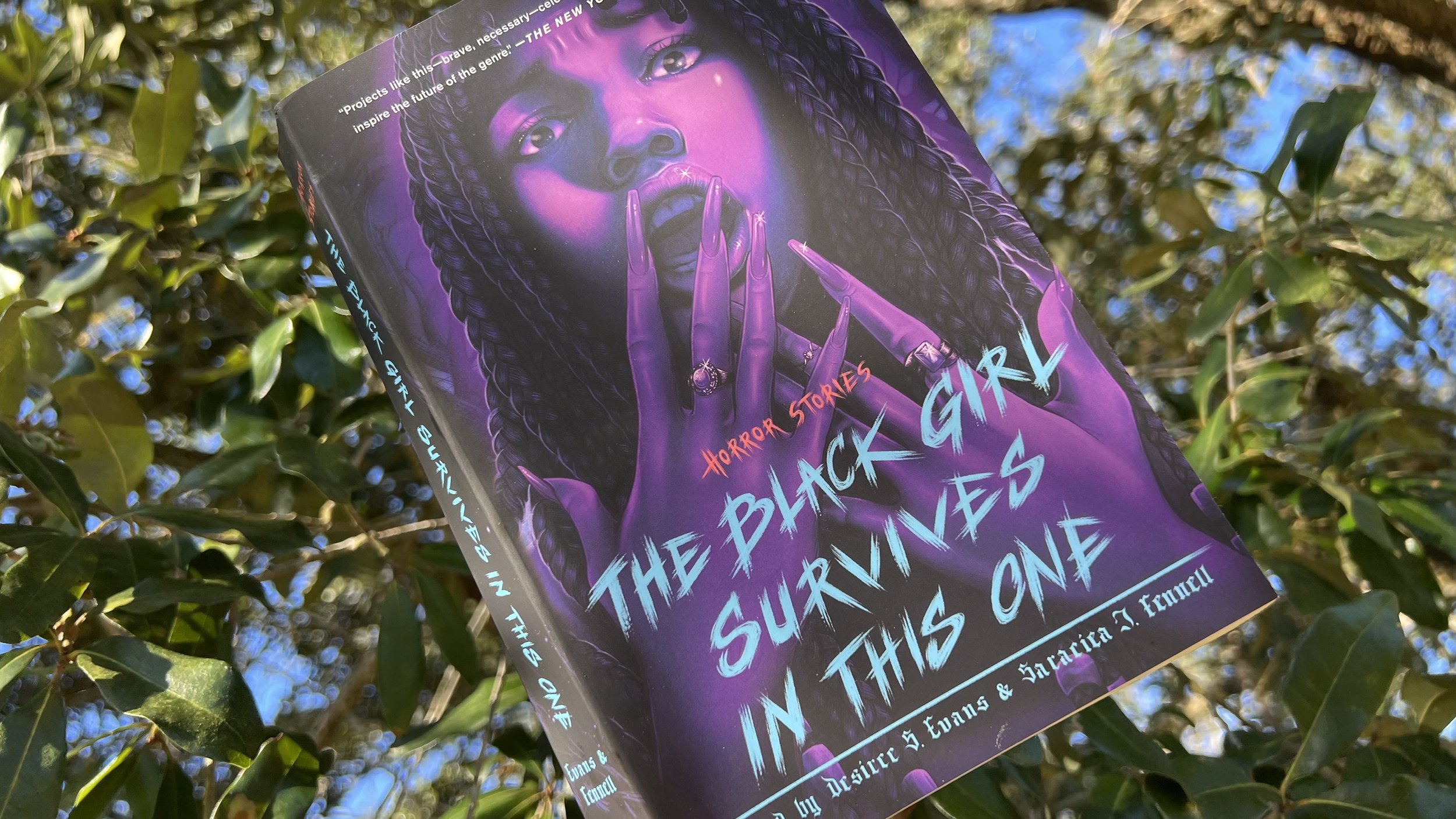
The Black Girl Survives in This One, edited by Desiree S. Evans & Saraciea J. Fennell
You mentioned Lois Lane. What other kind of things were you reading back then?
Oh, when I was a kid, when I was young, oh my gosh. I mean, I voraciously read everything. I was thinking about this the other day. Did I have one kind of thing that I read? I liked reading the encyclopedia. This is back in the day when we had those kind of things. Before Wikipedia. I loved going into those research holes, which is something I’m really bad at now still. I don’t want to leave the research hole! I would just pick a subject any week. I wanted to learn about Greek gods. I wanted to learn about the rivers of the world. Or just random subjects. I would go and find stuff and read books about them. Random characters from history that I want to know more about. So when I say that the library was my best friend, it was great because I was able to find out about anything. And that appealed to me. I don’t think I would be who I was in the world if I didn’t have the library to satisfy my curiosity as a young kid.
Did you have an interest in reading about St. Martinville, or about Louisiana back then as a kid?
I came to that much later and found it interesting the older I became. I don’t think I knew at the time how to access those books and histories outside of, like, the Louisiana history course we took in fifth or sixth grade, the one that we were required to take. It wasn’t until many, many, many, many years later that I was like, “Oh, is there anything written about where I come from?” And that actually began another kind of research hole much later in life, once I left Louisiana, went to college, lived everywhere else . . . I was actually asked this question the other day. I was on this panel for Southern Screen Festivals, I was on their panel for local writers, and one of the questions they asked was, you know, a lot of you write about Louisiana or you write about your towns where you come from. A lot of you came back to Louisiana. What was that like? Why did you come back? Why do you write about Louisiana? And my answer at the time was, “I left, and I went everywhere else, but really the place that I always found most interesting to write about was home.”
Ernest Gaines has this really famous quote about that as well, where everyone’s like, “Why do you write about Louisiana? What is this big Louisiana obsession that you have?” And he said something like, “I’m from Louisiana. I went to California for school, I went to all of these places, and it was Louisiana, and the stories of the people that I came from that held the most value for me.” And then he came back home to the land where his family worked for years. And I feel like when I read that, I was like, “Yeah, I just feel like there’s something . . . I didn’t mind writing short stories or articles about places I lived, Chicago, New York, North Carolina, but I felt like there was something that always drew me back to wanting to write about home. And maybe it was because I didn’t really know a lot about home growing up, or read a lot about home in the books that I read. I read books from everywhere else. I don’t think I can remember one book that was set in Louisiana that was given to me in school at any point, you know?
A lot of those stories were never written.
That’s what I found out much later. No stories that I grew up hearing about were ever put down into books. I looked around for the communities that I came from, the peoples that I came from, and the region that I came from, and I couldn’t find those in books. And I was like, “Wow!” It surprised me, because I think at the time I thought that everything had been written about. And I knew that no matter what I wanted to write about, I wanted to be able to set a lot of stories here in Louisiana and to capture some of the uniqueness. I left and lived in a lot of places, but I feel like there’s just something very unique here, something that I really love, and I want to be able to capture that in the stories I write.
Do you feel like St. Martin Parish specifically, or Louisiana more broadly, is a place that draws out a certain type of storytelling, or that is different from another place you might have grown up in?
Yeah. I think for me it does. I remember thinking, “I don’t want to have to move to New York to write.” That’s the thing you do, right? But some of the best writers in the world are from the South. Some of my favorite writers are from the South. Where did this idea come from that I have to move to New York to write? As a young writer, that just was in my head.
And I think there’s this pervasive attitude about the South, an automatic dismissal or downplaying of anything Southern. Like you were saying, the feeling that you have to move to New York where the real stories are, where the real writing happens. This idea of the South as somehow not quite measuring up.
I definitely encountered that dismissal. I mean, when I went to grad school and I was in school, even undergrad, I feel like there was also this dismissal of the South as an entire region. And then you look and you say, “Wait a second, some of the greatest writers that we’ve ever had, people who have made big changes in the world, somehow just get erased in this modern narrative of the South, which is silly. And, honestly, I feel like I do my best writing from here. You know, I lived in New York for several years. I could not write a word. It’s a very vibrant, beautiful city, but it was not where my inspiration came from. And I often felt like I could not find the brain space or the . . . whatever centered me in writing was not something that I found there. But when I came back home, I found that I flourished. And so I guess maybe just being here, surrounded by, I don’t know if there’s some woo-woo-ness of just being closer to the soil, to the ancestors, or the stories that I’ve been hearing. I don’t know.
I think so.
I definitely feel it. I love being here. I love being near our waterways. I love driving on back roads. And the stories come to me. Some of my best stories just come to me when I’m daydreaming. My father’s people grew up in North Louisiana, piney woods, beautiful piney wood forests. They were farmers as well. They grew up on their farm. And my father could navigate that land in the dark, these back winding roads. He would dangerously turn off the headlights and say, “Look at the roads I grew up on. I can navigate in the dark.” I’m like, “Dad, really!” And he would turn off the lights and navigate in the dark. But that was my father. He was a country boy, even though he moved to the city, moved to Shreveport later on in life. That’s where he had his family. But he was just such a country boy, and that really rubbed off on me, I think, growing up. This love of the country, love of being out in nature, in the dark, piney woods, and navigating them in the dark by heart.
And the space here, you can just expand, I think your mind can expand and open up in a way that, for me, doesn’t happen in other places.
Exactly. I thought I would be a big city girl. And living in all the big cities, I realized I am such a country girl, and I miss being in the country. I miss this porch sitting and sitting outside. Stories come to me that way. So, yeah, moving back home, everybody’s like, “Are you okay moving back home? Is it too quiet? Are you sure?” I’m like, “Y’all, it’s quiet. It’s peaceful. And I’ve written so much.” And I get to travel. I’m always traveling. But yeah, there’s definitely a reconnection coming back. I was driving around St. Martinville yesterday. My niece got married over by the Evangeline Oak. And so we were just driving around town and reminiscing. I love these old small towns. I love the back roads. I love driving around and writing about the little stories that happen here. Because I feel like big stories happen in small places, too. And when my novels do come out, hopefully I’ll have several set in this area. It’s a place that feeds a lot of my creativity, calms me down, centers me.
Inspires you, would you say?
Oh, absolutely. It inspires a lot of my work.
You’ve done different things, and you alluded to a novel that I guess you’re working on at the moment? Do you find like you’re someone who is going to continue to do a lot of different things in different areas? Are you dialing into what you’re doing?
What’s exciting about the current moment is that you can really do a lot of different things now. You kind of have to sometimes, because of the economy. You have to be versatile. The return of the Renaissance man-slash-woman. I might not ever be a journalist again, but I would still love to be able to write non-fiction works about a lot of the real places that inspire my work. I was talking with a cousin of mine about looking at her family and her histories of the area. I have a poetry collection that I might get out at one point. I love writing across age groups. I love writing for kids.
We have a literacy crisis in the U.S. What can you write, particularly when you’re writing stories for kids who don’t have books written about them? That’s one way of getting people to read again, getting people interested in stories again. I was doing a classroom visit about a year ago, and the way that kids light up when they see stories that they recognize, and they see places that they recognize in the books. I love Shakespeare, but sometimes you think, well what does Shakespeare have to do with me? It feels very foreign. I also feel that the way that literature is taught in schools, it becomes an alienating force for a lot of folks.
Like being forced to take a bad-tasting medicine.
Exactly. I see that even with my nephews who loved reading with me when they were younger, but when they got into schools, something just turned off. It was the way that it was taught to them in schools. In schools it was so boring to them. But when they were little, they loved reading with me. And so I’ve been trying to figure out what they were interested in and reframing it in different ways. I love my teachers, but sometimes schools are taught to the tests. It’s less about the enjoyment of the story sometimes. I want people to write books that kids will want to read.
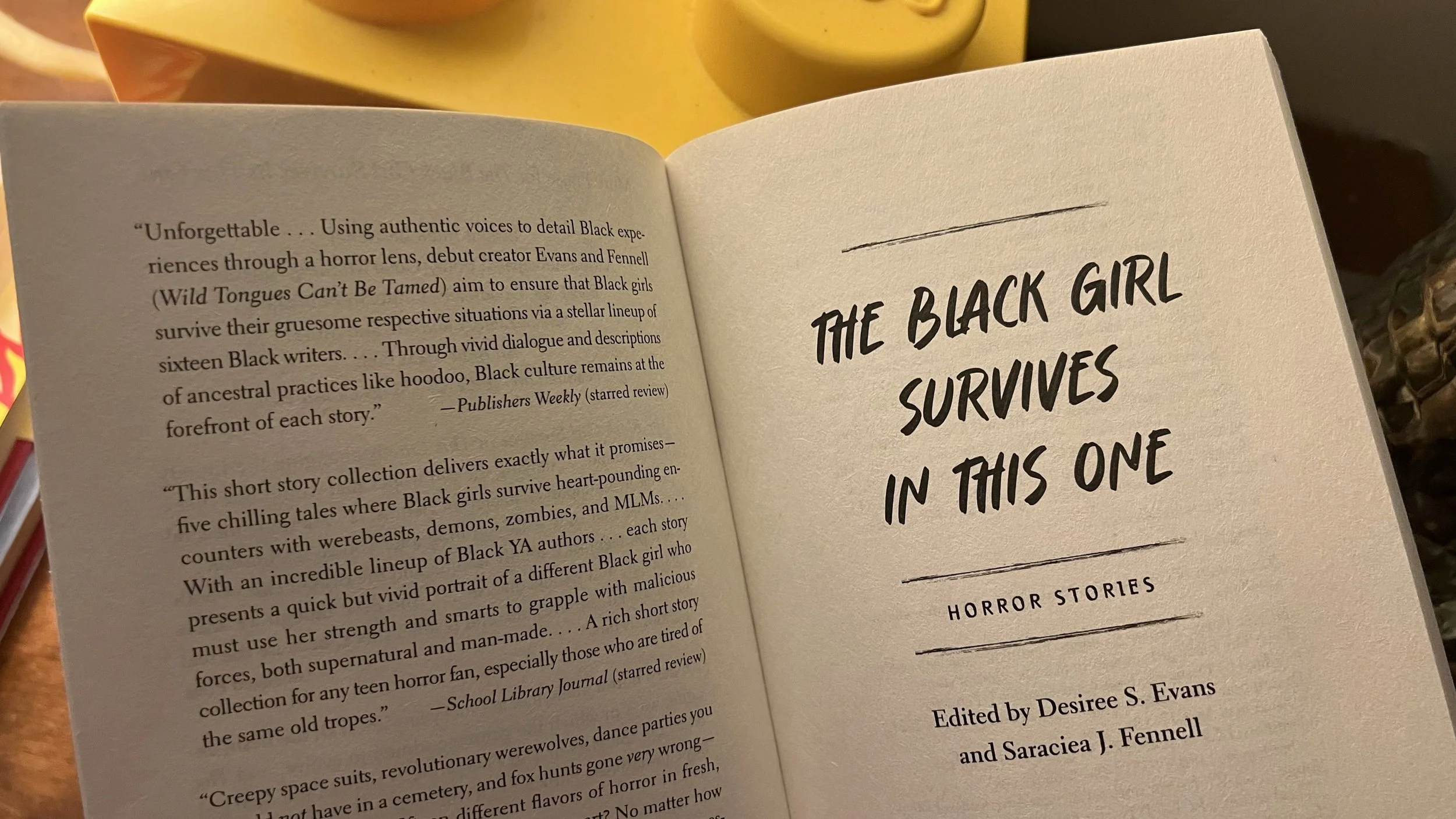
The Black Girl Survives in This One, edited by Desiree S. Evans & Saraciea J. Fennell
I wanted to ask you about the anthology you co-edited last year, The Black Girl Survives in This One. That title has stayed with me. I keep coming back to it over and over. There’s just such a power in that simple statement. How did the anthology come about?
A few years ago I was talking to my agent about what we might want to do, and I had this idea for an anthology. The horror genre was getting talked about. We were having a bit of a renaissance in the genre overall and in the movies. Jordan Peele had just come out with Get Out. And people were talking about, “Oh, black people like horror too.” And I was like, “Yes, we’re the biggest fans of horror. We love horror!” And so there was this renewal in the media, and I wanted to put together an anthology, particularly in the YA space, young adult space at the time, the teen space, because horror hadn’t really made a big comeback in that space yet. When I grew up I read everything, but I used to really, really love teen horror. I was a 90s kid, a 90s teen. So it was at a time when—I don’t know if you remember these books—but writers like R. L. Stine and Christopher Pike.
That’s a little bit after my time. I grew up on Stephen King and Clive Barker.
So you were earlier. But this shift happened in the 90s, because it had not always been directed to young adults. The whole YA/teen market is very, very new. I mean, there have always been books that were more taught towards kids, the books that we grew up reading but they didn’t really have a way of discerning between “this is for children” and “this is for adults” for a long time. And really that became more of a thing in the 60s and 70s, this idea of teen literature. This market became a thing. I feel like that has to do with that time period and the idea of what it meant to be a teen. And then in the 80s you started to see more of that popularized. The 90s was all about the Scholastic Book Fairs. Scholastic became its own children’s imprint, and they brought books into schools. So that was really huge. I mean, across the nation, we had these book fairs in schools, and that’s where I got introduced into the teen horror market, and I feel like most people across the nation did, because those Scholastic book fairs brought them into schools, and they were cheap, and there were all these paperback books that were like three dollars. It was a phenomenon. So the 90s had these cheap teen pulp horror paperbacks that became super popular.
And there were writers who were writing towards that market. Writers like R. L. Stine and Christopher Pike were really big back then. And they just wrote these long series that were just silly, silly, beautiful book series that we ate up when we were eleven and twelve years old. I used to have these milk crates full of books, you know, I would carry them around and be like, “I’m on book number 50, blah, blah, series blah, blah.” And before that, we mostly had, like, Sweet Valley High and The Hardy Boys and Nancy Drew. You started to see a genre coming into play. And so when I met my co-editor, we talked about that. She’s a few years younger than me. She grew up more in the Goosebumps era. I don’t know if you know Goosebumps, which is like a few years younger than me, but my little sister grew up reading those books. And I was reading a little bit of the other books before that. That was a great time. That 90s teen era of falling in love with reading horror. That was our gateway into horror. We read all those books, but we never saw any black people in any of those books. And so we thought it would be really great to kind of talk back to the larger horror moment that was happening, writing back to the tropes of 60s and 70s horror, like The Final Girl.
The Final Girl?
So there’s this academic book that came out in the 80s that was looking at slasher movies of the 70s and 80s. And horror in general is always a reflection of society’s anxieties and issues and fears and urban legends. All of this is about what are we afraid of? So at this time, people were afraid of women going out and having too much independence. And there’s a warning to you: you might get killed. Horror has all these things about our culture norms and fears. But one of the most interesting developments out of that period was this idea of The Final Girl, which is like the last girl left at the end of a horror movie, usually a slasher movie, where all of her friends have been killed. And she survived this onslaught, and she’s the last one standing. She’s the last one left to tell the story. But also, there’s a kind of morality tale about her. She was usually a virginal, pristine character. She had to be a very good girl, you know. All the ones who got killed were the bad girls. So there’s all these wild tropes about that. And there have been a lot of books writing back to that idea of what makes a Final Girl, who deserves to be a Final Girl.
You don’t see a lot of black Final Girls, because in order to be the Final Girl you have to be this ideal Americana ingenue, a pristine character, and black women and black girls are always written outside of that norm, right? And if you do see us in horror movies, we’re often stuck in this . . . it’s a leftover of slave-era ideas of, like, the helper character, right? Sometimes there would be The Sassy Best Friend. There’s a lot of great scholarship written around The Magical Negro character, who would have this almost supernatural wisdom about all the woo things that were happening. And you would knock on their door and get your advice before you go off to fight The Big Evil.
Ancillary characters.
Yeah, they’re ancillary, helper characters that give wisdom and advice. Sidekick characters. And often they were one of the first to die. They helped you out, they gave you wisdom, and then they were killed off. That’s part of the onslaught. And that’s really pretty much where they appeared, if they appeared at all. Toni Morrison wrote a lot about this in her scholarship, about how in a lot of southern gothic literature, in a lot of Southern writing, Black people were there even when they weren’t there. Because often, so much of the writing was writing around and almost against these institutions that were so much about how blackness was policed, and so in a lot of Southern Gothic, in Faulkner, a lot of it was writing around this almost invisible, undiscussed otherness. And going back even further, a lot of the original Gothic literature came up in a time of colonialism. Who was the boogeyman? Who was the other that they were afraid of? It was these nations that they were colonizing. It was India. It was Africa. The Dark Other was a thing that became symbolized by the monsters that they wrote about, by the ghosts and the guilts and the horrors that they were writing about. The age of science fiction and horror was all about how do we reckon with colonialism? Sci-fi in its earliest forms—I point this out to people all the time and they’re like, “Oh my God, you’re absolutely right. I never thought about that.” It was all about alien visitors. We’re afraid of people colonizing us the way the West was colonizing other countries.
So when you look at any of that old science fiction it was all about projection, the West projecting into the world what they were doing in other places. And that was definitely something that happened, too, in a lot of the Southern Gothic and Southern horror literature, you see. We were there, even when we weren’t there. Stephen King and his haunted Native American burial grounds. What is that about? What is that history? What are those histories?
I write about this a lot too, this idea that every plantation in the South is haunted. There’s always ghost stories about slaves. The way that we understand hauntedness and horror is so intimately linked to the history of enslavement and colonization and all of that in the West. But we’re not able to talk about it, so it pops up in our stories. And so anyway, all of that was what we were thinking about. How do we play with this idea, this trope, that the black person always dies first in horror? We had a list of our favorite Final Girls, and we could think of maybe one or two black girls in twenty years of horror films. We never could survive. So we decided to do this black horror anthology to speak to the moment, to invite a curiosity around horror and black horror into the young adult space to hopefully encourage more black writers to write horror in that space.
One of the interesting things about YA literature, a new market, really, in the last 20 years, was the popularity and the money-making of the market. And that all goes back to Harry Potter, which came out in the late 90s. And then there was Twilight and Hunger Games. That trio of books really made the market what it is today. Before that, it was just kind of a sleeper market. The 90s had a little boom, but it wasn’t really a New-York-Times-best-selling market until Harry Potter came out. But again, it was never a market that saw a lot of diversity.
When I was growing up, we definitely didn’t have anything. And in this whole boom of the market from the early 2000s, up until I would say even five years ago, there were just not many black writers in that space. I can count them on one hand. Definitely none of them had major series or major books, even though it became a huge market space. It begins to feel like black people, or people of color, queer people, or any marginalized group, just couldn’t imagine themselves into other places and times. They couldn’t go to Narnia. They couldn’t go ride a dragon. It limited the imagination. I mean, the biggest joke about science fiction is that you wrote about these amazing, futuristic universes, but where were the people of color? The majority of the planet just disappears in the future?
The imagination expands so much in one direction and stays so small in another way.
We’re still seeing that every time we do some sort of fantasy series, whether it’s Marvel or Game of Thrones, they’ll get so upset if you have people of color in those universes. You can have dragons that are talking, you can have elves, but yet the fact that you can have people of color in these fantasy worlds . . .
That’s a step too far.
Oh my god, they’re always yelling at Marvel for casting people of color, they’re always yelling at Star Wars for casting people of color, even though Star Wars has this diverse array of aliens. I mean, you can see a red alien, a blue alien, orange aliens.
I think you can take the title of that anthology, The Black Girl Survives in this one, and see the relationship between storytelling and survival in a more concrete way.
It’s kind of a spoiler—the black girl survives in this one—but also, like, there’s a comfort in knowing that ending, too. Because of this trope, horror tends to be one of the most optimistic genres. There’s a lot of horror that’s just dark and depressing, but ironically in a lot of this genre horror you know there’s going to always be a survivor.
Somebody’s going to survive.
The Final Girl as a trope gives you the idea. You see her, you see her introduced. Oh, “She’s going to survive.” Her friends might not survive, but you know, she’s going to come out of that. So we have these Sigourney Weaver types, think about Alien, think about Sidney from Scream, and we have Jamie Lee Curtis’s character in Halloween, these strong women characters. You saw them develop in the movies from these innocent adults into these kick-ass characters who, you know, punch the alien in the face.
They fight back.
They’ve learned to fight back, which is a very empowering space. And I feel like YA and teen readers were really introduced to that. The teen heroine became a very empowering, girl-powered space. I blame Buffy—Buffy the Vampire Slayer, which I love—who I think is modeled after Sigourney Weaver. These young punch-back kind of characters. And so you have this teen protagonist who’s often a young girl battling many horrible things and winning in the end, right? And so a lot of what our book is responding to is like great, we love that. Young girl readers are really finding themselves in these characters. Again, there are no black girls who are fighting back and winning. And I was like, “Well, I look around, and that’s what I see every day.” So in certain ways, even if you’re using a genre like fantasy or horror to reflect that, it was really important for us to be able to be like, “We see survivors every day.” And even if we don’t survive, what would it be to imagine our survival?
At the time when I was writing, I was dealing with a lot of health stuff, I had a lot of family members . . . I was just seeing a lot of, particularly black women in my family and communities, I’m looking around and seeing that women are fighting and going ride-or-die for their communities, and it’s all these amazing black women. I was like, “Okay, survivors, even if you don’t survive, you’re fighting to survive. You’re fighting against the biggest monsters I know!”
And so for me it was like, “How do I channel that into a space which I would love for people in my community to read, to take action and fight against the monsters?” So all that was sort of in my head when I was thinking about this anthology. The Black Girl Survives in This One was a way of fighting back against the trope when we didn’t survive, but also a way of manifesting that into the future. We will survive. I always say in my books: You will survive. All the stuff you’re going through. I had this one little girl who came up to me. Her mother came up to me at a book signing. She’s like, “She’s going through a lot in school right now. She’s having a lot of issues.” And I said, “You know what? Read this book. Write to me if you have some feelings about it. You’ll get through this. You’ll survive this. Just use this as one way of vicariously fighting the demons that you’re probably fighting in real life.”
That’s beautiful.
Just the idea of practicing at survival is what I was trying to get across in these stories. Because, again, stories are where I learned survival. And I think that’s where the imaginary, that’s where the fantastic comes into play. Books help us practice that. Before you can build something, you have to fantasize about it. You have to imagine it. One of our oldest forms of storytelling was the Black fantastic and the Black imaginary. Even Harriet Tubman says that before she was able to get her folks to freedom she had a dream that she was free. And she would tell people this story that she dreamed that she was free. And people could call that a science fiction story. That was not a reality. That was a fantastical story that she told over and over again until she made it a reality. I don’t know if you’re familiar with writers like Virginia Hamilton, who’s an amazing Black folklorist and writer. She wrote some of our oldest folk stories. She has this beautiful story of people that fly. Have you heard this African-American story? It’s a very sad story when you actually analyze it, but this is this idea of all these slaves are just flying away, flying away, flying away back towards freedom. And I’m like, “That’s absolutely a speculative story.” So how do we talk about that in the history of speculative fiction and science fiction when you say we didn’t write those stories? We were always writing those stories. All those stories about freedom and imagining different realities, those are all beautiful speculative stories that fed us and enabled us to imagine our actual freedom. And I think about that in church traditions too.
Sermons!
Oh my gosh, absolutely. All those parables and allegories, absolutely. Sermons are another performance. Mapping so many ideas of what the future can hold and what it could be. And having people reframe how they think about the traditions and looking at these other places that the stories were being told in. Storytelling and survival, right? As one way of imagining our survival, but also, we survive in stories. We survive through stories. I think that’s part of what interests me in stories. They have lessons that we can hold on to. Right now I’m writing a middle-grade adventure that I’ve been having a lot of fun with. I love other folklore as well that deals with a lot of these untold histories. And the little girl is able to map her own family’s history through these untold histories of Louisiana and Texas, and that is just so much fun. Some ten or eleven year olds are going to find the book, hopefully, and think about, well, what are my own family stories? How can I do that for my own family? It’s showing them what’s possible.
I want to thank you for your time today, and I have one more question for you. What do you think about when you look back at your time growing up in St. Martinville?
I remember how much joy we found, even when life wasn’t easy. We spent so much time outside with family, sitting around, talking, catching up on everything. Holidays meant Easter fish fries and big spring crawfish boils where everyone showed up. My mama always made crawfish étouffée when I came home from college. It was my favorite, served up with a side of her potato salad. Zydeco was the music of my whole childhood. It played at every birthday party, every family reunion, every trail ride, every holiday. I didn’t realize until I left home that most people outside of Louisiana had never even heard of it!
My sister and I were talking the other day about how we used to walk all over town when we were kids, trek miles and miles across the town, whether going to the candy lady, the snowball stand, or the video rental store. The trail rides are another thing that stays with me. They showed what Afro-Creole cowboy culture looked like long before we knew its lineage. I grew up thinking it was normal to ride in a hay wagon in the middle of a big field while people on horseback circled around and Zydeco blasted from a speaker. Those rides started in South Louisiana and then spread across the South, but to me they were always just part of the texture of home.
And Mardi Gras! Nothing beat the parade in St. Martinville. It was run for more than 50 years by the Newcomers Club, one of the oldest Black mutual-aid groups in southwest Louisiana. I loved seeing the St. Martinville High band and majorettes, along with performances from other local schools. It was our whole community coming out to celebrate ourselves. It still makes me sad that the city doesn’t allow the parade anymore. It really was something special.
Festival season meant heading to neighboring towns for the Sugarcane Festival, the Crawfish Festival, etc. Years later I tried to explain to a friend who was not from Louisiana about how our culture celebrated all the foods we ate! I remember taking graduation photos under the Evangeline Oak, and just recently saw my niece get married there. All those small traditions linger. St. Martinville definitely shaped me in those everyday moments, in family gatherings, in the music and food and the hot summer days that lingered.